Dog Age Chart: Compare the Real Age of Your Pet
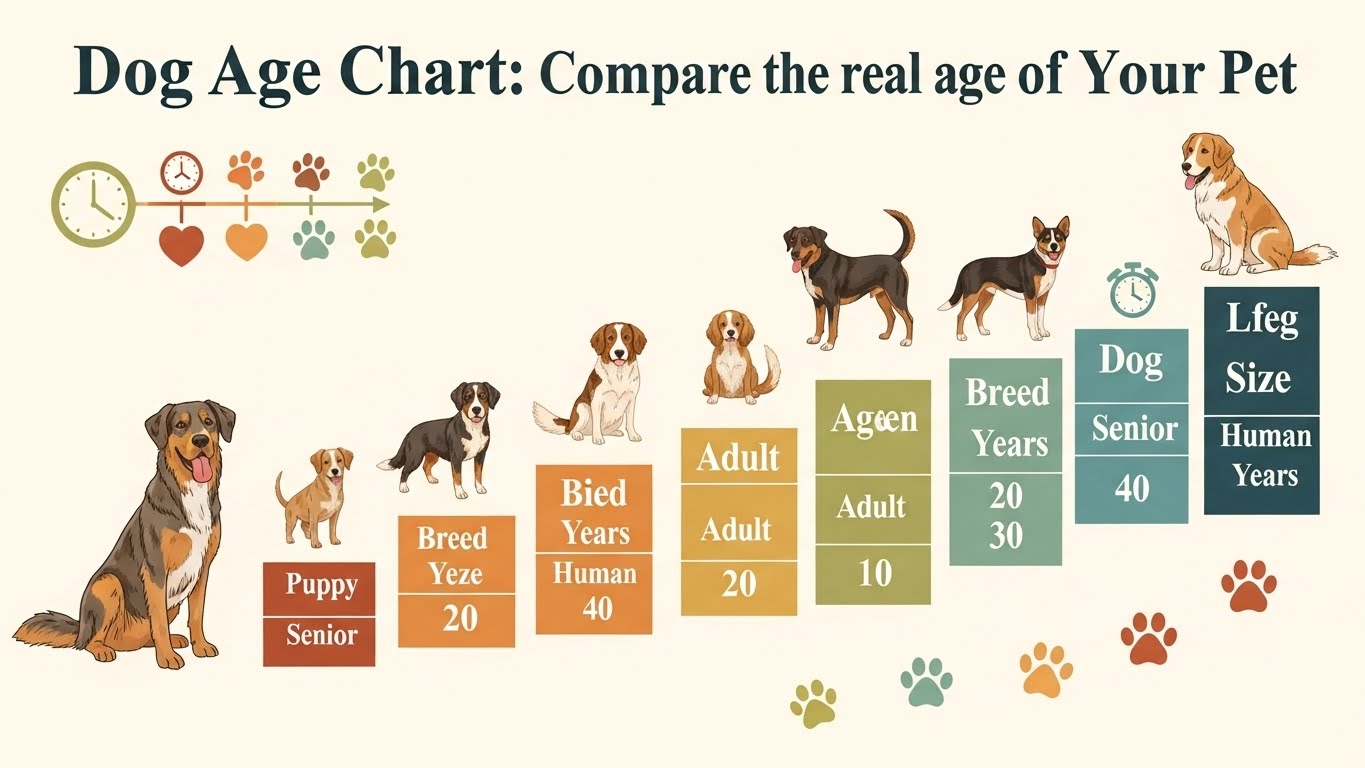
My cousin has had a dog age chart in her kitchen cabinet for the past 10 years. It is stained with coffee and marked down the edges, however, I consult it all the time, when it comes to determining whether my terrier is interested in senior food, when it comes to explaining to clients why their Great Dane needs joint supplements at four years old, and when it comes to clarifying to friends whether their rescue dog is in its developmental phase.
A good dog age chart is not merely a chart for converting numbers; it provides a roadmap for your dog's entire life. Having trained hundreds of dogs of all breeds and sizes, I have come to understand that these charts are essential tools that guide our thinking about misconceptions about dog ageing and how we can better care for our dogs.
What a Dog Age Chart Reality Tells
An extensive age chart of dogs shows the correlation between calendar age and biological age across various size groups. In contrast to the simplistic "multiply by seven" method, quality charts indicate that the pace of ageing is fast in puppyhood, medium in middle age, and extreme depending on the breed size.
Most charts are arranged in columns: dog years, small breeds, medium, large, and giant dogs, with their respective human age comparisons. Other sophisticated models provide additional information, such as the age at which individuals are classified into various life stages, common health problems at each age, and treatment recommendations.
Size Categories Matter
The most crucial step in using a dog age chart is determining your dog's size category. Small breeds typically weigh less than 20 pounds, such as Chihuahuas, Yorkies, and Toy Poodles. Medium breeds weigh 20-50 pounds and include Beagles, Cocker Spaniels, and Border Collies.
Large dogs range from 50 to 90 pounds and include Labrador Retrievers, German Shepherds, and Golden Retrievers. Giant breeds are over 90 pounds: Great Danes, Mastiffs, Saint Bernards. The distance between classes is significant. Most dog age charts indicate that the age of a small-breed dog is approximately 44 human years at seven years old, whereas a giant-breed dog is approximately 56 human years at seven years old.
Mixed Breed Considerations
There is some estimation involved in using a dog age chart for mixed breeds, particularly for rescues of unknown parentage. I typically consider adult weight a determinant once the dogs have reached full size. A mixed breed of 35 pounds falls under the medium category, irrespective of genetic composition.
For puppies, you will need to determine the approximate adult size using paw size, parental details (when available), or growth estimates from a veterinarian. I adopted a puppy last year, whose size at maturity was anyone's guess. Our dog's age chart was in the medium-breed column until she reached adulthood, at which point we switched to a large-breed calculator, and she has reached 62 pounds. It is not ideal, but it is reasonably practical.
The First Two Years on the Chart
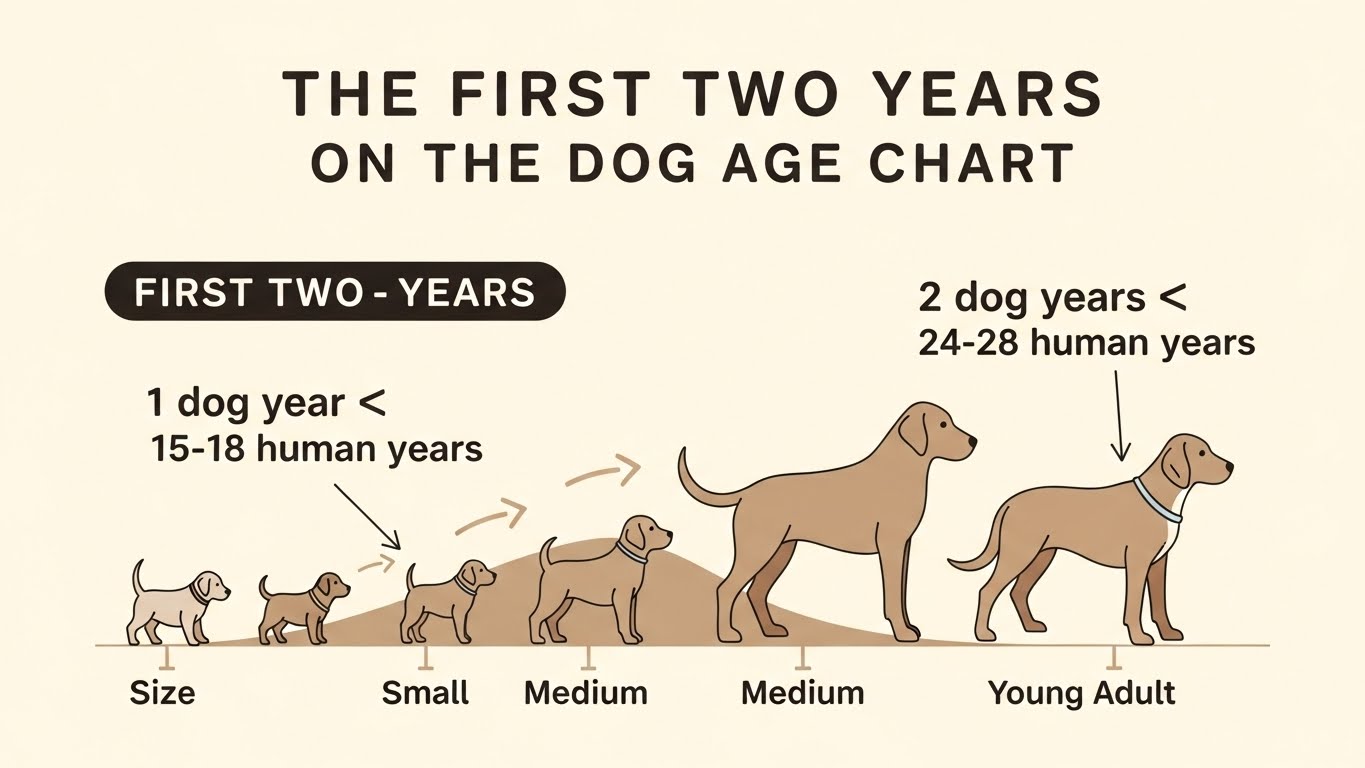
All the dog age charts show the most significant changes in the first two years. The first year is an explosive period of growth that does not fit human ageing at all. In most charts, a one-year-old dog is estimated to be equal to 15-18 human years, depending on the dog's size. The latter year is also a considerable ageing burden that makes two-year-old dogs reach around 24-28 years of age in humans.
My experience with puppies is extensive enough to witness this rapid maturation firsthand: how the helpless eight-week-old puppy becomes a full-fledged, well-coordinated, and personality-filled yearling in a very short time. When an owner looks at a dog age chart, they are reminded that their puppy will be a young adult in just a few months.
Middle Age Among the Breeds
Age progression on a dog age chart differs in the middle range, between ages three and seven. During this period, small-breed dogs reach what would appear to be middle age (approximately 4 human years per year), yet they retain youthful energy. Medium breeds grow at approximately 5 years per calendar year.
Large breeds mature at approximately 6 years of age in one year, and giant breeds mature even quicker at approximately 7-8 human years per year. I have this experience at the dog park. A six-year-old Jack Russell terrier (approximately 40 human years) owned by my friend still plays like a young adult, whereas a six-year-old Bernese Mountain dog (approximately 52 human years, according to the chart) has become more sluggish.
When "Senior" Status Begins
Dog age charts typically highlight senior or older generations with colour modifications or markings, and these ages differ substantially by size. Small breeds usually do not reach senior age until 10-12 years of age. Medium-sized breeds reach maturity at 8-10 years of age. Large breeds become seniors at 6-8 years, and giant breeds may be regarded as seniors at 5-6 years.
This fact also directly affects veterinary care. At the age of 6, I initiated an annual senior blood panel for my dog, based on the dog age chart, which indicated that she had attained senior age at approximately 48 human years. At the same time, my neighbour's Miniature Schnauzer is just beginning senior screening, even though the dog is only four years old on paper.
Health Impact at Each Stage
An age chart for a dog can help you predict age-related health issues. The preventive care required for children and young adults differs from that for older adults. The chart shows that, at a human scale, in their fifties, dogs undergo significant screenings, namely thyroid panels, kidney tests, liver function tests, and dental checkups.
I will use the chart to explain to clients why their apparently healthy seven-year-old Labrador requires more comprehensive testing than their three-year-old. The graph provides visual evidence that their dog has matured from approximately 30 to the late 50s within four years. This helps justify the cost and importance of appropriate senior care that detects issues early.
Nutritional Modifications by Chart Stage
Dog food manufacturers have developed formulas for each stage of a dog's life, and a dog age chart can help determine when to transition. The first year is the most dramatic period in a dog's life, as puppy food supports rapid growth. Adult formulae maintain health in the middle ages. Senior diets are responsive to metabolic changes and support ageing organs.
The difficulty lies in deciding when to switch, because size is important for timing. My Jack Russell became a senior at age eleven (approximately 60 human years on the chart). In contrast, my friend altered her Rottweiler at age seven (approximately 54 human years), because our decisions aligned with our respective age charts for dogs and the conditions of our dogs.
Changes in Exercise over the Years
A dog's age can also help determine what to expect when exercising. Human-equivalent young adult dogs between twenty and thirty years require intensive daily physical exercise. In dogs, activities should be maintained into their fifties and sixties, although with some adjustments to joint health and endurance.
I adjust my training recommendations based on the dogs' positions on the age chart. An example is a 5-year-old Border Collie (approximately 36 human years; medium-sized breed) that tolerates aggressive agility training. A 5-year-old Great Dane (approximately 45 human years) should engage in less strenuous exercise to prevent joint injury. The chart enables owners to recognise that these adjustments are not due to laziness but to age-related care.
Comparing Your Dog to the Chart
The process of using a dog age chart requires you to be honest about where your dog really is. Enter your dog's calendar age in the left column, then cross-reference to the appropriate size category. The cross indicates your dog's approximate human age equivalent. This should be done annually, and the outcome should be recorded, along with any changes in care that the outcome may recommend.
Some owners are unwilling to accept their dogs' ageing and continue activities at the level of puppies, even in old age. Other people fuss over dogs and treat them as weak when in reality they are only middle-aged. The chart provides objective points of reference against which we can set aside our emotional inclinations.
Limitations of Any Age Chart
No dog age chart takes into account individual variation in the rate of ageing. Nutritional quality, genetic factors, access to healthcare, regular exercise, and even mental stimulation all contribute to the ageing process in individual dogs. I have personally known extremely healthy-looking Labrador Retrievers at 12 years old that appeared years younger than the chart indicated.
The chart provides population averages that give a rough idea of what to expect, but it cannot predict your particular dog. I consistently inform clients that they should integrate the chart with veterinary evaluation and monitoring of their dog's actual mobility, cognitive function, energy level, and overall health.
Make Your Own Reference System
Although numerous ready-made dog age charts are available online and in veterinary clinics, developing your own tracking system is worthwhile. I have a basic spreadsheet that contains the birthdates, current ages, chart-based human counterparts, and observations regarding health or behavioural changes in my dogs.
This becomes a longitudinal record that enables you to identify patterns and make informed care decisions. Others use a highlighter to mark their dog's current position on the chart they use and update it annually. Some prefer digital versions in pet care applications. The format is less important than the regular reference to a credible chart that recognises breed-size differences.
Other Practical Applications Out of Healthcare
Dog age charts are used to make decisions outside of medical care. They contribute to training expectations: you cannot expect a 60-year-old human being to acquire and develop at the same rate as a 25-year-old, and similarly, you should not expect the same of dogs. Insurance companies sometimes use age to determine eligibility for coverage.
I also use charts to help families decide whether to adopt a second dog, ensuring the dogs are compatible in age. A two-year-old puppy (approximately 24 human years) may overwhelm a calm senior (approximately 72 human years), but the chart makes this age difference more understandable than calendar years do.
Frequently Asked Questions
What is the accuracy of dog age charts?
Age charts for dogs based on current research provide reasonable estimates of the average size within each size category. Nevertheless, individual differences imply that charts are only rough guides to your dog.
Which dog age chart do I need?
Select graphs from veterinary sources or other organisations, such as the AKC, that involve recent studies and breed-size corrections. Not to use charts that still use the long-lived rule of seven-year multiplication.
Are mixed breeds of dogs responsive to dog age charts?
Yes, use your dog's weight when it has grown to determine the appropriate size classification. When you are certain that your mixed breed is small, medium, large or giant, the chart will also work the same.
At what age should I begin treating my dog as a senior?
Check your age chart for your dog's specific breed size. Small breeds at 10-12 years, medium between 8-10 years, large between 6-8 years, and giant between 5-6 years.
Is it necessary to change care only because of the chart?
The chart is just one factor to consider. Care decisions should be based on the dog's actual physical condition, veterinary examination, and personal health, rather than chart position.
Calculate Your Dog's Real Age
Use our accurate dog age calculator to determine your pet's true biological age based on breed size and compare it to our comprehensive age chart.
Try Dog Age Calculator