Puppy Size Predictor: How Big Will Your Dog Get?
Why Knowing Your Puppy's Adult Size Matters
I adopted a first rescue puppy, and when I brought her home, the shelter estimated she would weigh about 40 pounds as an adult. Two years later, she had gained 85 pounds. This made me realize it is essential to know a puppy's expected size before purchasing. The size of your puppy will influence what kind of crates to buy and even the fence in your backyard.
It affects food expenses, exercise needs, and even housing choices for residents of weight-limited apartments. Many individuals surrender their dogs to shelters because they underestimate how large their adorable puppy will grow.
Finding a relatively precise size estimate can assist you in being ready, in all aspects, monetarily, physically, and emotionally, to satisfy your dog in its entirety. An accurate predictor of puppy size eliminates the guesswork of prospects considering adding a new family member.
How Puppy Size Predictors Work
Predictors of puppy size are mathematical equations that use current weight, age, and breed traits to estimate adult size. The majority of calculators take the weight of your puppy and multiply it by some pre-established factor at a certain age.
For example, several equations indicate that multiplying a puppy's weight by 4 after 4 months can be used to estimate adult weight for medium breeds. These instruments examine patterns in growth-rate data reported by researchers over decades of research on canine development.
There are different formulas for small, medium, large, and giant breeds, as each category has a different growth curve. Small breeds usually attain full size in ten months, whereas giant breeds can keep growing to a size that is reached at the age of two. Knowledge of these fundamental differences helps you select the appropriate prediction method. No calculator is truly accurate, but most are helpful for ballpark estimates when the right breed considerations are applied.
The Paw Size Method
Among the folk ways, one of the most famous is making your puppy stretch out its paws to determine the size in adulthood. According to the theory, puppies with large paws relative to body size will mature into large adults. This method has validity because paw proportions indicate skeletal development.
Nevertheless, I have seen such exceptions frequently, which makes this approach unreliable on its own. Some breeds are larger by nature, with paws that remain proportionally larger throughout their lives, while others are proportionally small. The examples include bulldogs, which have compact paws yet stocky bodies.
Large paws allow hunting breeds to navigate their territory, yet they are not massive dogs—one measure among many, rather than a single prediction mechanism. By integrating paw observation with weight-based calculation, the results are more accurate and reliable than those from either method alone.
Prediction Formulas Based on Weight
The most scientifically sound strategy is weight-based calculations at the defined stages of development. With small breeds that weigh less than 20 pounds in adult weight, four times the weight at six weeks is to be multiplied. Medium breeds are useful for doubling weight at four months of age. Big breeds are more challenging to work out, using a multiplication in most instances: 16 weeks × 2.5 of the weight.
Giant breeds are the most difficult to handle because they mature significantly more slowly than other breeds. Most veterinarians recommend that predictions for giant breeds be made six months later and then doubled. Such formulas are based on studies of growth curves reported in veterinary journals over the past few decades.
I have used various calculation techniques while working with veterinary professionals over the past several years with client animals. Weight-based formulas are always more accurate than visual assessment or paw size, even though breed knowledge can make any of the methods more precise.
Genetic Factors That Determine Growth
There is finally a genetic factor in your puppy that will determine its adult size, unlike environmental factors. Given parents' sizes, you have the most accurate predictor of all tools. Puppy size is usually within the parents' stipulated range, with a tendency toward one parent's size. It is also genetic, as male dogs tend to weigh 10-20 percent more than female members of the same litter.
The recessive genes sometimes result in puppies that are much bigger or smaller than the anticipated parents. This genetic variability is why littermates can have vastly different adult sizes. Your breeder can provide additional data on the grandparents' size. Multi-generational size consistency implies more acceptable results.
Genetic tests currently offer limited information on breed structure and expected size, especially for mixed-breed dogs whose parentage is unknown.
Breed-Specific Growth Patterns
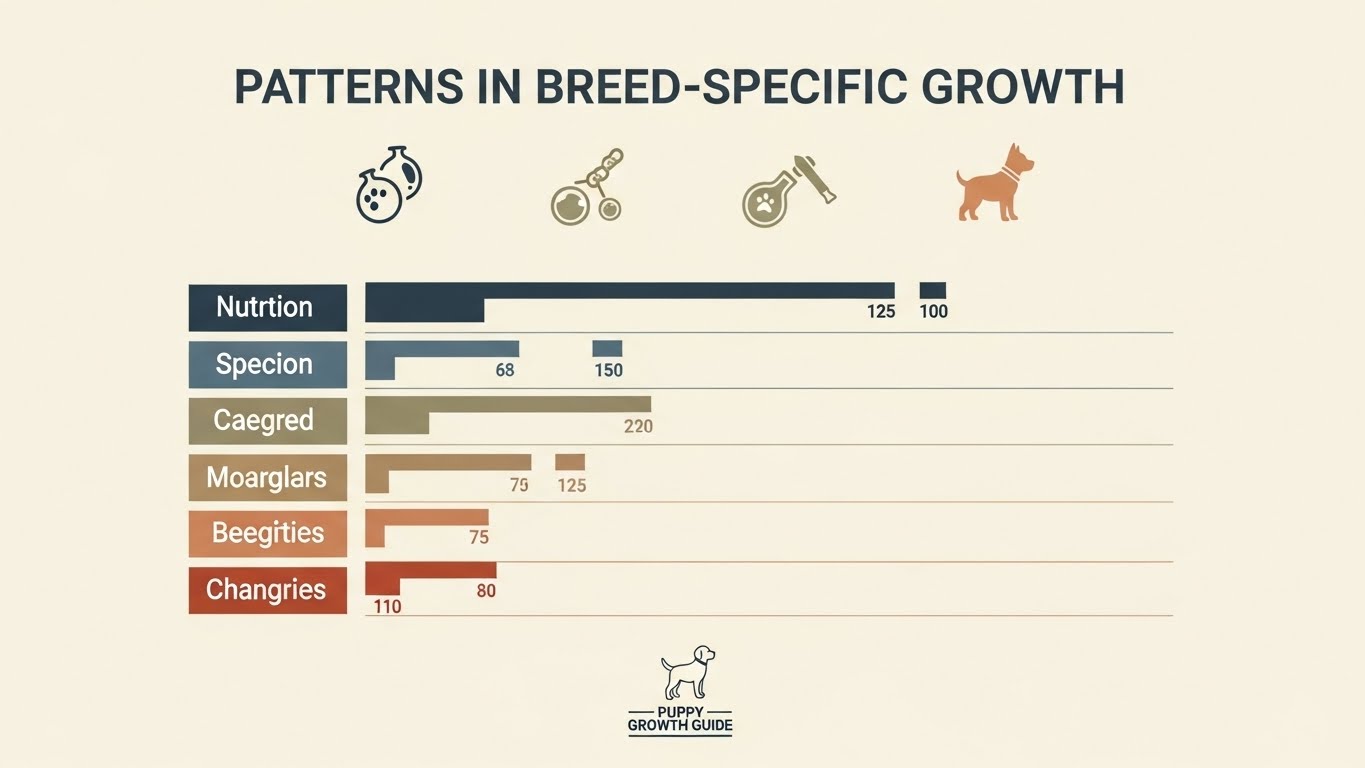
Knowing the breed of your puppy significantly enhances the extent to which you can predict its behavior by virtue of the fact that the various breeds have incredibly different growth patterns. Small dog breeds and toy breeds, such as Chihuahuas and Yorkshire Terriers, typically reach maturity between eight and twelve months.
Medium-sized breeds such as Beagles and Australian Shepherds usually reach maturity at 12 to 15 months. Big dogs, such as Labrador Retrievers and German Shepherds, continue to post until they are eighteen months old. Large dogs such as Great Danes and Mastiffs do not reach maturity until two or three years old.
These schedules are essential because prediction formulae do not yield practical results when applied at the wrong age. A six-month-old Great Dane has a lot further to grow than a six-month-old Beagle. You can use the information to predict the correct formula by researching your dog breed and its typical growth patterns, then apply it at an appropriate developmental stage.
Issues Related to Mixed Breed Predictions
The most difficult to predict are mixed-breed puppies, whose genetic makeup is mainly unknown. When you are not familiar with the parent breeds, the best you can do is an educated guess. I have volunteered at rescue agencies where the mixed-breed puppies turned out to be much larger than expected.
A puppy of what was supposed to be a small-breed mix reached seventy pounds, and another pup of a larger breed reached thirty-five. DNA tests are helpful for breed composition and provide predictive results. When your mixed-breed dog has more Labrador genes, you can expect some traits characteristic of Labs.
Things are complicated by multiple breed effects, whereby genes that affect size can be of any ancestral origin. For mixed breeds, I would use larger-scale metrics rather than make pound predictions. Consider higher variance and anticipate surprises on both sides of the expected range.
Growth Milestones to Track
Parenting your puppy involves tracking its growth milestones, which provide real-time updates on its projected size. Most puppies gain the bulk of their weight in the first six months, after which the rate slows. Small breeds can only gain ounces a week during their most active growth stages, whereas giant breed puppies can gain several pounds in a week.
Weekly weight tracking is a good example; it helps you identify trends and compare them with breed-specific growth charts. Wellness puppy weight checks are part of standard veterinary practice and provide reliable long-term data points. This also indicates that you should reconsider your size goals based on your puppy's presumed breed when they are significantly above or below standard growth curves.
Growth spurts occur haphazardly, with single measurements telling less than patterns over weeks. This tracking method is particularly effective for mixed-breed cases, as breed-based predictions are unreliable. The data you have built up is becoming increasingly valuable as you identify trends.
The Role of Nutrition in Size Development
The maximum size of your puppy is determined by genetics, but nutrition determines whether you actually reach it. When undernourished, no growth will take place, and being fat will not make a dog bigger, but instead lead to obesity and joint disorders. Puppies require the right calories and nutrients in accordance with their desired adult size.
Giant and large-breed puppies ready for home should be fed a specially formulated food that manages calcium-to-phosphorus ratios to prevent orthopedic diseases during puppy development. The rapid growth of bones in a Great Dane puppy through the use of standard puppy food is potentially fatal because the newly developed joints cannot support the growing bones.
On the other hand, feeding a Chihuahua large-breed puppy food provides an inadequate nutritional balance. Healthy nutrition supports healthy growth to genetically determined adult size. Discuss the appropriate diet with your puppy veterinarian. It is worth remembering that predictions of size have nutritional implications, and that any degree of reasonable accuracy would be of practical importance beyond curiosity.
When Forecasts Are Not Accurate
Predictions are not as accurate as they should be, despite proper calculations and breed knowledge. Health issues may affect the final size if problems arise during the puppy stage. Growth trajectories can be affected by parasites, chronic illnesses, or hormonal imbalances. The ability to grow and build structure also depends on the timing of spaying or neutering, as early sterilization can delay closure of the growth plate, resulting in a lankier build.
If your puppy is developing more slowly or faster than expected, consult a vet to rule out medical causes. Other times, predictions do not work because of genetics, and no one can do anything about them. Your puppy might have recessive genes from many generations ago that override parental expectations.
Also acknowledge the fact that prediction tools do not provide guarantees. Be mentally and practically prepared for dogs that are larger or smaller than expected. Flexibility is more effective than strict expectations about how adults should look for new puppy owners.
Achieving the Best Size Prediction
The use of a combination of more than two approaches provides the best predictions for puppy sizes. Start with parent size, then add the weight-based calculations required for your puppy type. Use paw size and the general structure of bones as evidence. In mixed-breed dogs, DNA testing provides helpful information on breed composition. Record the growth every week to observe the trends.
Ask your veterinarian, the one who deals with thousands of puppies of any breed and has the wisdom of experience. Online puppy size calculators are a good starting point if you enter accurate information about weight and breed.
It is important to remember that all predictions are based on estimates, especially when dealing with mixed breeds and puppies younger than four months. Real-world predictions should be practical and flexible. Whatever the genetics dictate, whether your cute puppy is a small dog or a large one, their height will be that at any rate. Love them as large as they grow, even when preparations are comparatively few.
Frequently Asked Questions
What is the accuracy of predictors of puppy size?
Most predictors of puppy size can predict size within an error range of 10-20 percent when the dogs are purebred. Mixed breeds are more variable because some may be missing as much as 30 percent or more of their genetic material due to unknown genetic factors.
How can I determine how big my puppy will be when it grows up?
Most breeds can be predicted accurately after four months. Giant breeds typically wait until six months, while toy breeds can be estimated at eight weeks.
Do big paws mean a big dog?
Large paws are usually a sign of adult size, but they are not a reliable indicator. Other breeds, by nature, have proportionally larger or smaller paws, irrespective of size.
Will my puppy be like their parents?
Puppies can be raised to be slightly larger or smaller than their parents. Male offspring tend to grow 10-20 percent bigger than those of the same litter of females.
When do puppies stop growing?
Small breeds reach maturity at 10-12 months; medium breeds at 12-15 months; large breeds at 18 months; and giant breeds may reach 2-3 years.
Predict Your Puppy's Adult Size Today
Use our puppy size predictor tools to estimate your dog's adult weight and plan for their future needs.
Try Our Calculators