Puppy Maturity Calculator: Your Complete Guide
Introduction to Puppy Development Tracking
The first pup I took home was an outgoing Golden Retriever named Scout, and I was completely unaware of the expected development milestones. At six months, would she have quieted down? A year? Two years?
These are the questions the very new owner of a puppy wants answered, and, honestly, their answers cannot be easily found. A puppy maturity calculator became a guide in determining at what stage Scout was between her playful fur ball and a mature dog.
These tools will account for breed size, weight, and genetic composition to determine when your puppy reaches each developmental stage. Knowledge of maturity schedules is functional across all areas, including expectations for training, diet changes, and starting more intensive exercise programs.
What Is a Puppy Maturity Calculator?
A puppy maturity calculator is a computer application that estimates when your dog will physically, sexually, and emotionally mature, based on specific entries about your dog. You usually include details: your puppy's current age, breed, current weight, and expected adult weight.
The calculator then creates rough timetables of various development milestones. Imagine it as a growth chart, similar to those used by pediatricians for children, adapted to reflect canine developmental trends. Such calculators are based on credible research and veterinary breed-specific findings, providing effective estimates.
They are, however, guidelines, not timelines. I have tested several calculators over the years and used them with different dogs. The variations in results were minor, but the overall time frames were the same.
The Importance of Learning Puppy Maturity
Knowing when your puppy will mature is not merely a matter of curiosity, but it directly affects day-to-day decisions that affect your dog's long-term health. For example, if a large-breed puppy is fed an adult diet too soon, it may develop bone and joint problems due to significant differences in nutritional needs across growth stages.
Equally, emotional maturity can help establish realistic training expectations. I recall the time when my one-year-old Lab kept behaving like a maniac even when I took him for walks, and I was left baffled because I had not known that, in the case of Labs, it would take three or so years for them to mature emotionally.
This would have saved me significant stress and unnecessary expenses. Maturity is crucial for exercise intensity, spay or neuter timing, and awareness of behavioral changes. It is healthier and more effective to apply your care strategy to your puppy's current developmental stage.
The Process of Puppy Maturity Calculators
Most puppy maturity calculators use algorithms grounded in established veterinary research on canine growth patterns. The first concept is that small dogs grow faster than large dogs, as well-documented in the scientific literature.
When you enter the puppy's breed and expected adult size, the calculator uses relevant growth curves to make a more or less accurate prediction of when the puppy will mature. Even sophisticated calculators will account for details such as whether your dog is purebred or a mix, since hybrid vigor slightly affects growth patterns.
The most accurate assessment of physical, sexual, and mental or emotional maturity, as distinct phenomena, does not necessarily occur at the same time. They generally report results by age range rather than specific dates because there is natural variation in individual development. Primary data comes from decades of veterinary experience with thousands of dogs.
Important Factors That Determine Puppy Maturity

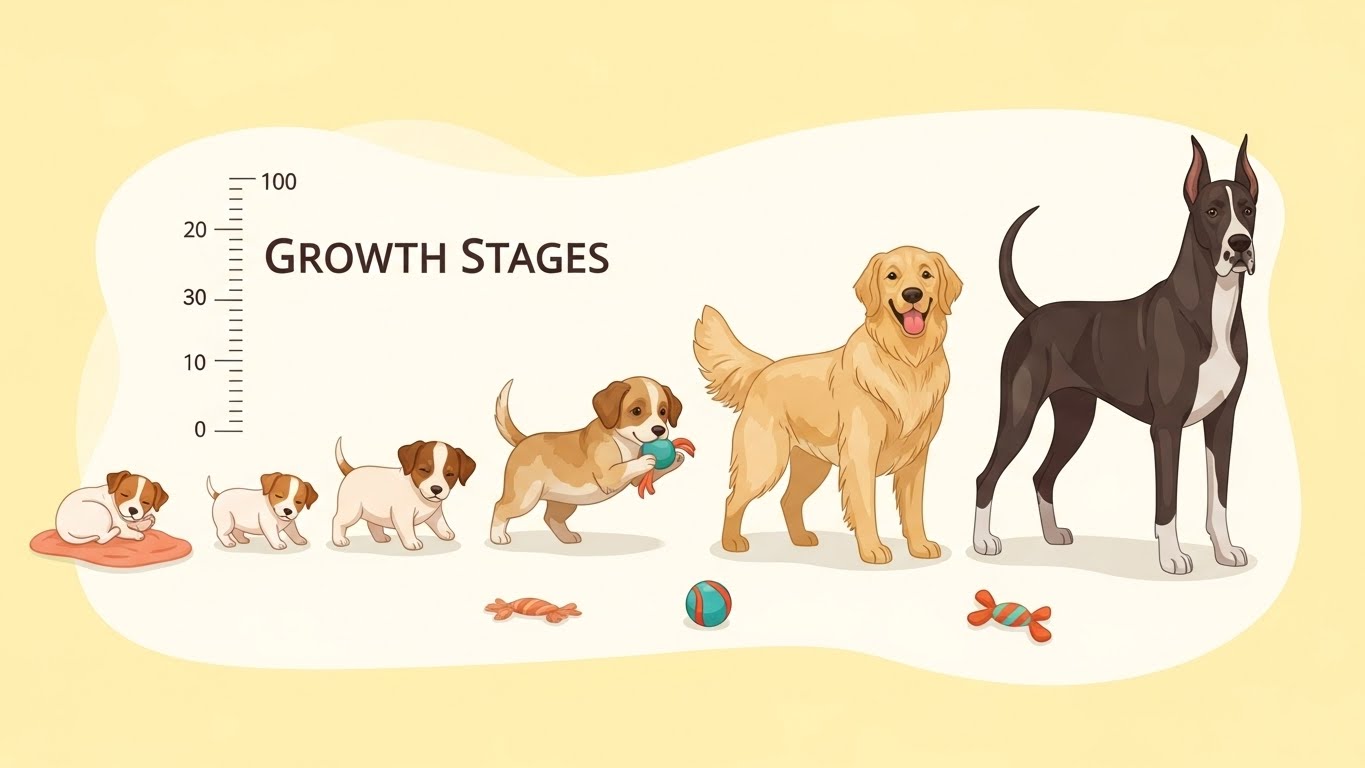
Several factors influence the speed at which your puppy matures to adulthood, with the most important being its breed size. A Chihuahua should be physically mature at the age of nine months or so, whereas a Great Dane may not realize this until the age of two.
Genetics also contributes to breed type; some bloodlines grow up faster than others. Growth rates are influenced by nutrition; a well-balanced diet supports healthy growth, while malnutrition may lead to slower growth or malformation. The timing of spaying or neutering affects the closure of growth plates, which may affect eventual size and maturity age.
Depending on health conditions, a puppy's development can accelerate or slow. Even environmental factors, such as stress levels and activity levels, contribute to overall maturity development. Knowledge of these influences helps analyze calculator results more accurately, and it is possible to understand that two puppies of the same breed may reach maturity at different times.
Small vs Large Breeds: Maturity Timeline
The maturity schedule between small- and large-breed dogs is significant and worth exploring. Physical maturity: Small breeds typically reach it between nine and twelve months of age. They may appear to be adults until they are one year old, or behavioral maturity may take a few extra months.
The medium-sized breeds between thirty and fifty pounds, as a rule, grow physically at twelve or fifteen months but mentally at eighteen months or two years. Large breeds ranging between fifty and one hundred pounds usually take eighteen months or two years to grow physically, whereas giant breeds above a hundred pounds may still grow through to the age of two or three.
The Irish Wolfhound owned by my friend literally grew over almost three years, which is an immeasurably long time compared with the Yorkshire Terrier of my neighbor, who appeared mature enough at the age of ten months.
Behavioral Maturity vs Physical Maturity
A significant difference the puppy maturity calculators account for is that physical and behavioral development are not equal. Physical maturity is when your dog has reached full skeletal maturity, reached an adult weight, and has matured sexually.
Behavioral or emotional maturity, in turn, includes impulse control, maintaining attention, reducing hyperactivity, and responsible temperament. Emotional maturity is nearly always accompanied by physical maturation, sometimes by months or even years. This is why a one-year-old German Shepherd appears to be an adult dog but acts like a teenager.
In most cases, owners end up confused or frustrated at this stage, when the full-sized dog they own still bounces off the walls. It is also essential to recognize that a physically mature dog may not be mentally mature, so a person should be patient when continuing training. These types of development are estimated independently by most quality puppy maturity calculators.
How to Use Puppy Maturity Calculator
The most precise results of a puppy maturity calculator are obtained through the input of accurate information. The first step is to know your puppy's exact age, in weeks or months, not rounded. In the case of a mixed breed, you can estimate the anticipated adult weight by the size of the parents (assuming that you know the sizes of the parents), or ask your veterinarian to make informed assumptions.
Weigh your puppy regularly; the date of the growth-rate measurement improves prediction accuracy. Compare results from two or three calculators to obtain a more accurate range than relying on a single estimate. Above everything, however, use the results as a guiding rule, not as a sure-footed one.
Individual variation means that your puppy may grow a bit faster or slower than expected. Plan with the information, whether it is scheduling spay or neuter appointments, changing food types, or setting training expectations, but do not be bound to rules; modify your plan as you actually observe the animal.
Signs of Your Puppy Growing into Adulthood
In addition to using calculator estimates, it is better to rely on real-world indicators as the puppy approaches adulthood. The physical signs include stunted or absent growth, adult fur rather than puppy fur, and consistent weight after several weeks.
Teeth mature over approximately seven months, and all adult teeth have developed; the primary and deciduous teeth have been replaced. Sexual maturity evidently differs between males and females, but in most cases, it begins to show signs between six and twelve months.
Some signs of behavioral maturation are not always obvious, including a progressively longer attention span during training, less damaging chewing, less reactive responses to stimuli, and improved impulse control around food and other dogs. Your puppy's uncontrollable behavior, which occurred a few months ago, may calm down without constant supervision. There is a tendency toward more stable sleep patterns, and energy levels, though healthy, are more manageable. These readings should be similar to those in the calculator.
Common Myths About Puppy Development
Several myths about puppy maturity should be dispelled, as they lead to poor care decisions. The first stereotype is that all dogs become mature at twelve months old - totally inaccurate, as the size of the breed makes a lot of difference. Another myth is that physical size indicates maturity, but a larger puppy does not necessarily imply greater maturity than a smaller one.
It is commonly believed that early spaying or neutering helps dogs mature faster, but research shows it may delay growth plate closure and hinder certain developmental stages. The claim that puppies automatically outgrow behavioral problems is neither accurate nor true; training remains vital, even as they mature.
Lastly, the myth that mature dogs do not play vigorously is not justified. Older dogs require play and exercise; they simply regulate their energy differently than puppies. Quality puppy maturity calculators and veterinary advice can help separate fact from fiction by aligning with developmental expectations.
Adjusting Care Based on Maturity Stage
As your puppy progresses through developmental stages, as indicated by maturity calculators, you may need to adjust its care. When you reach physical maturity, which is usually the physical maturity estimate given by your calculator, then puppy food needs to graduate to adult formulations.
With exercise, it is possible to gradually increase intensity and duration once growth plates are closed, which reduces injury risk. Training methods could change, including the introduction of more complex skills, as mental maturity increases attention span. Socialization cannot be overlooked; it simply becomes more subtle as your dog matures and develops a certain temperament.
Veterinary care is shifting toward annual checkups rather than regular visits. Mental enrichment is, in fact, more in demand when the cognitive growth progresses - the more advanced, the more demanding the desired enrichment is. Planning these transitions using maturity calculator timelines will help ensure a suitable transition, avoiding changes too early or wasting unnecessary time.
Limitations of Puppy Maturity Calculators
Puppy maturity calculators are helpful, but several factors limit them. They are not capable of explaining intra-breed genetic variation, i.e., that your individual dog may not conform to breed means. Most calculators do not account for health, nutrition, and environmental factors, yet these play an important role in actual development.
Mixed-breed forecasts are more uncertain because genetic combinations can produce growth patterns that are impossible to predict. Although calculator algorithms are based on veterinary research, they reduce the complexity of biological processes to general estimates. Neither can they anticipate temperament in the behavioral sense; maturity age has nothing to tell us what you will find your dog to be like in their adulthood, whether calm or energetic.
Take these tools as informative beginnings rather than final answers. A combination of estimations by the calculator and the recommendation of a veterinarian, as well as the personal observation of your particular puppy, will give the best image of the development rate and the right time of care provision.
Frequently Asked Questions
What is the accuracy of the calculators of puppy maturity?
Most calculators provide relatively precise estimates within a few weeks to months, particularly for purebred dogs. Accuracy is lower with mixed-race individuals or those with abnormal size changes. They are loosely applicable as guidelines rather than strict forecasts.
At what age do the majority of puppies reach their full maturity?
Small breeds typically grow after twelve months, medium breeds between fifteen and eighteen months, and large or giant breeds can attain full growth in two to three years, after which physical and psychological maturity is complete.
Are maturity calculators applicable to the case of mixed-breed puppies?
Yes, but get the expectation off. Guess the weight of your mixed breed when the animal is an adult, depending on the size of the parent animal, or when you know, or request advice from your veterinarian to enhance the accuracy of the calculator.
Are there sex differences in the speed of maturation of male and female puppies?
As a rule, female creatures reach sexual maturity slightly earlier than male creatures. In contrast, the time frames for physical and emotional maturation are similar across sexes within the same breed size group.
Will nutrition help accelerate my puppy's maturation?
Absolutely. Healthy nutrition helps in having a healthy maturity, and poor nutrition might retard maturity. Large breeds experience abnormal growth rates and developmental issues due to overfeeding.
Track Your Puppy's Maturity Today
Use our puppy maturity calculators to understand your dog's developmental stages and plan their care accordingly.
Try Our Calculators