Puppy Food Calculator: Perfect Portions Guide
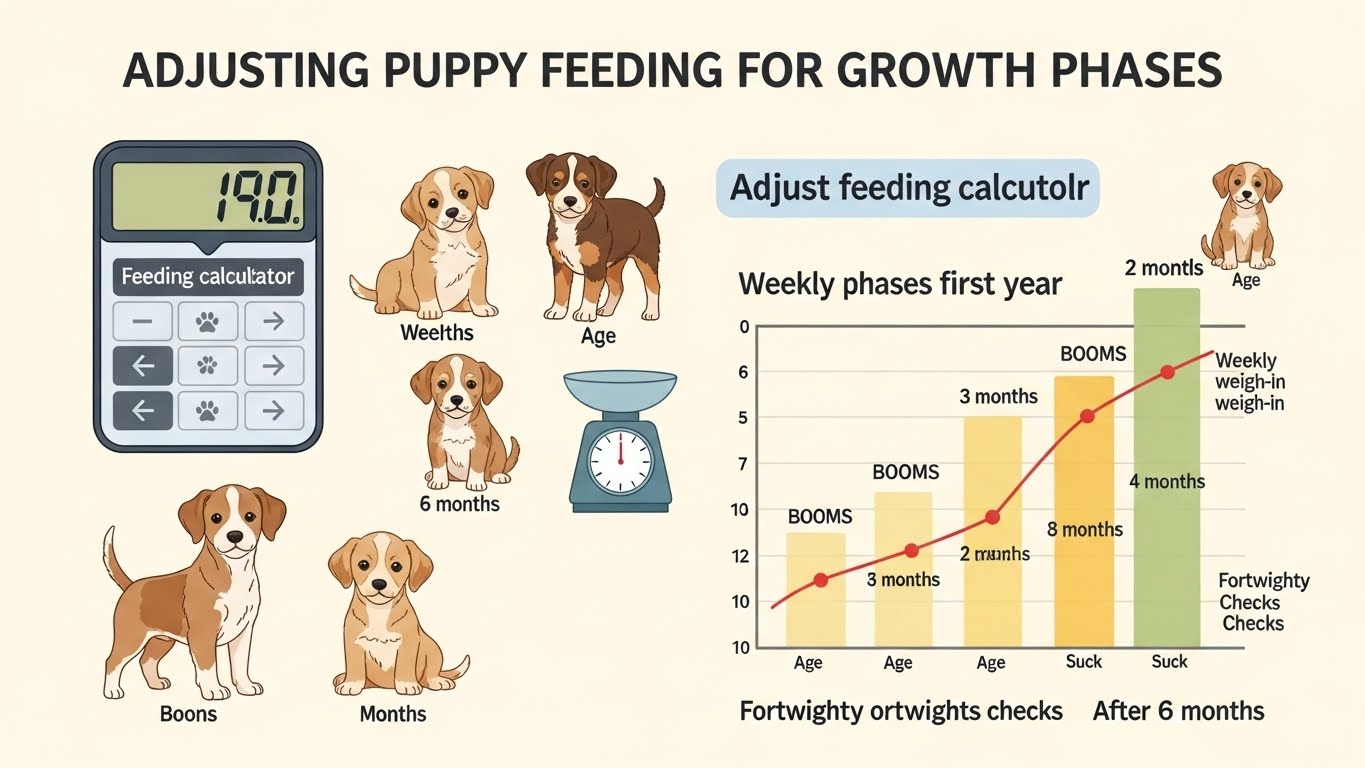
The Reason Puppies Require Special Feeding Calculations
Raising a puppy is not as simple as raising an adult dog in miniature. The nutritional needs of puppies are significantly different because pugs are developing bones, muscles, organs, and brains at a rapid rate. I have raised puppies of many other breeds, and the rate of growth in the first few months is incredible; some gain several pounds a week.
The puppy food calculator is a tool that addresses these specific needs by considering the current age, weight, breed size, and anticipated adult weight. The generic feeding guidelines are usually ineffective because a Chihuahua puppy and even a Great Dane puppy at the same age require radically different nutrition, even though their current weights are similar.
The calculator eliminates the usual errors of underfeeding, growth retardation, or overfeeding, as well as developmental orthopaedic complications, particularly in large breeds. A healthy life for your puppy is achieved by using appropriate calculations from the start.
The Difference Between Puppy Food Calculators
Contrary to adult dog calculators, which focus on maintenance calories, puppy calculators account for growth energy needs. The mathematical equations account for increased metabolic rate and energy required for tissue formation. The majority of them multiply by 2.0 to 3.0 times the resting energy requirement, which is 1.2 to 1.6 times in adult dogs.
I have checked the results of the adult and puppy calculators using the same weight, and the puppy suggestion was always half to twice the adult value. Small breeds (under 20 pounds as adults), medium breeds (20-50 pounds), large breeds (50-90 pounds), and giant breeds (over 90 pounds) are separated by the best calculators due to significantly different growth patterns and body length. Small breeds reach adulthood after 9-12 months and giant breeds after 18-24 months. Such a prolonged growth period for larger puppies requires alternative feeding strategies.
Some Vital Knowledge You Will Require
Before using a puppy food calculator, collect the necessary information to obtain precise results. You will need your puppy's age in weeks or months; this is precisely what is required because needs vary so quickly. A current weight is essential, and a modern veterinary checkup is preferred. Breed or breed mix helps you estimate adult size if you are unsure.
This is more difficult with mixed breeds, though your vet can often estimate based on paw size, parental data, and current growth pattern. You will need the calorie content of your puppy food, which is given as kcal/cup or kcal/kg. The calorie content of puppy food typically ranges from 350 to 500 calories per cup, depending on the ingredients and brand.
Other calculators ask for the activity level, but most puppies are naturally in the moderate-to-active range. I maintain a simple spreadsheet to record my puppies' weekly weights, and it has helped me identify growth trends and make necessary adjustments to the calculator inputs.
The Puppy Calculator to Be Relied On
Not every puppy food calculator is equal. I trust people in veterinary colleges, veterinary nutritionist organisations, and established pet nutrition researchers, rather than random blog calculators. The Pet Nutrition Alliance offers a science-based calculator created by board-certified veterinary nutritionists. Similarly, veterinary schools, such as UC Davis and Ohio State, provide calculators that incorporate up-to-date research.
A few high-end puppy food brands offer calculators, but they are effective only when you use their products, as they are programmed to follow specific formulas. Watch out for oversimplified calculators that merely request weight now and do not account for age or breed size.
The most useful calculators provide ranges rather than precise values and include instructions for adjusting them based on body condition. I usually use two good calculators when getting a new puppy. Recommendations should fall within 10-15 per cent, then I will go ahead.
Disaggregation of Feeding Frequency
Puppy food calculators show daily amounts, but these must be divided in a specific way to support digestion and maintain normal blood sugar levels. Between weaning and approximately 12 weeks of age, I feed puppies four times a day, spaced approximately 4 hours apart. This eliminates hypoglycemia in small puppies and reduces digestive congestion. At ages 12-16, switch to three meals per day.
At about 6 months, most puppies switch to twice-daily feeding, although small breeds may be able to stick with three meals for an extra couple of months. I have discovered that there is no harm in increasing the frequency and length of meals, but decreasing the frequency too quickly may result in vomiting, diarrhoea, or hyperphagia.
If a calculator indicates your puppy needs 600 calories per day and you feed four times a day, each meal requires 150 calories. Conversely, the less frequently meals are eaten, the larger the individual portions should be, while keeping the total number of servings per day fixed.
Adjusting for Growth Phases
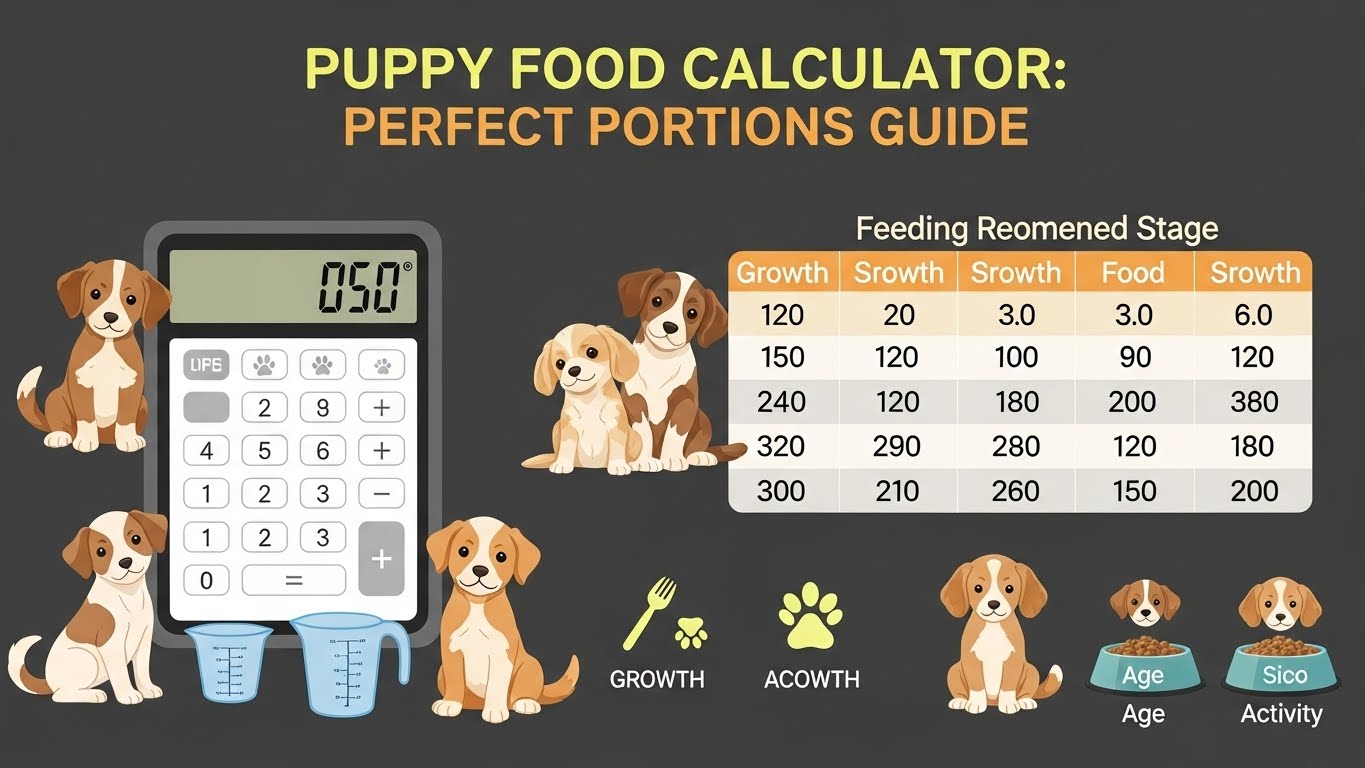
Puppies do not develop consistently; therefore, they experience booms and troughs. The calculator's initial figures are approximate, but you will see significant changes in the first year. I weigh puppies at the end of each growth stage once a week, and after six months, once a fortnight.
During growth spurts (ages 3-6 months), your puppy may require 10-20 per cent more food than the calculated amount. Symptoms include rapid meal completion and an apparent hunger despite being in a lean condition. My portions are gradually increased, say 10 per cent at a time, and recalculated based on the weight gain.
On the other hand, certain puppies do not require much during plateau periods. Do not free-feed puppies based on the total calculated quantity at each feeding. This will allow you to monitor the specific amount they are consuming and adjust it systematically. Big- and giant-breed puppies require special care because, during growth, their bones may be affected by overfeeding. In these breeds, I will be more conservative and keep the body lean rather than chubby, even if I may be feeding the animal slightly below the calculator's recommendation.
Calculations of Small Breeds and Large Breeds
Calculator results are highly dependent on the category of size you choose. Puppies of small breeds have higher metabolic rates and mature earlier than large breeds, so they require more calories per pound. A 5-pound Pomeranian puppy could require 400 calories/day, 80 calories/kg.
In the meantime, a 40-pound Labrador puppy could be consuming 1,600 calories, only 40 calories per pound. It is not a calculator error; it reflects fundamental metabolic differences. I have had both toy and giant breeds, and the difference is impressive. My Mastiff puppies also consumed moderate amounts relative to their size, but their growth was gradual.
My Papillon puppies appeared to gain weight in proportion to their food intake, yet remained small. Controlled growth nutrition is a deliberate effort by large- and giant-breed breeders to prevent developmental Orthopaedic diseases such as hip dysplasia and osteochondrosis by limiting excessive growth. These conditions increase with rapid growth; thus, calculators maintain relatively lean puppies during development compared with smaller breeds.
Growing Old to Young
The majority of puppies are fed as adults between 9-12 months for small breeds and 12-18 months for large breeds; giant breeds do not always transition out of puppy food until 24 months. Such a change is necessary to recalculate using an adult-dog calculator. The difference is considerable - most of the puppies require 30-50 per cent of the food when they are changed to maintenance nutrition.
I have observed owners feeding puppy portions to adult dogs, resulting in overweight young dogs within a few months. Begin transitioning by increasing the percentage of adult food over 7-10 days, while gradually decreasing portions. Enter the weight and activity level of your dog in an adult calculator after the complete transition of the diet.
Other dogs require transition phases: they are technically adults but are still slightly more active than usual and need a slightly higher maintenance percentage than average. Be careful about body condition during these months, as it is easy to gain excess weight without realising it.
Training Treats Compensate for the Costs of Training
There is a lot of treat consumption during puppy training, and calories can accumulate easily. I often find that people rely on calculators for dietary advice and reward dogs with unlimited treats, which makes them fat. According to veterinary recommendations, no more than 10 per cent of daily calories should be in treats.
Assuming your daily food intake is 800 calories, there is a limit of 80 calories for treats, which is about 8-10 small training treats, depending on the brand. I use several techniques to optimise training and manage calories. To begin with, I use small portions of snacks, usually cutting commercial snacks into quarters. Second, I retain a portion of the calculated meals as training rewards, which are used during the day. Third, to support basic training, I choose low-calorie options such as small portions of carrots, green beans, or plain air-popped popcorn.
For puppies that need intensive training, I first determine the calories from treats and the remaining calories from meals. This keeps the overall intake in the appropriate proportion regardless of training intensity.
Body Condition Monitoring
Even with frequent body condition analysis, the calculator results are meaningless. I train puppies after a week, using the same methods as with adult dogs, with minor adjustments. With light pressure, you should not see ribs but can easily feel them. Above, one should have a slight waist behind the ribs, but not as much as in adults.
On the side, there should be a humble abdominal tuck. Puppies have more body fat than adults, so you should not strive to achieve the lean, athletic appearance of a mature dog. I have also been taught that breed differences are essential. Sighthound puppies, such as greyhounds, are naturally lean, whereas breeds such as Labrador Retrievers can become chubby when overfed.
Ask your veterinarian or research your particular breed's healthy puppy look. When the ribs are hard to palpate or the waist is absent, reduce the amounts by one-tenth. If ribs are overly visible or energy is low, add 10%.
Indications of Veterinary Override of Calculators
There are cases where professional nutritional guidance is necessary rather than relying on standard calculators. Puppies who have a medical problem such as diabetes, heart defects or kidney issues require special diets. I collaborated with a puppy with a diagnosis of juvenile renal disease that needed alternative protein concentration levels; the standard calculators would have been detrimental.
Calculations are not the same with the orphaned puppies that are bottle-fed and the puppies that are weaned naturally. Poorly fed puppies rescued from neglect cases may require rehabilitation feeding, which should start at a lower level and be raised gradually to a normal level rather than going straight to the calculator recommendations.
On the other hand, some puppies have conditions that require a limited-calorie diet, even though they are still young. I have been exposed to puppies who had orthopaedic surgeries and had to put on weight to limit the stress on the joints. Always keep in mind that if your puppy has known health problems, is not growing in accordance with breed standards, or looks ill, do not rely solely on the calculators.
High vs. Low Food Concerns
The quality of puppy food will influence how much you feed, as its digestibility and calorie content differ considerably. High-protein, low-starch premium puppy foods typically contain 400-500 calories per cup. Foods containing grain fillers and lower-quality protein may contain 300-350 calories per cup.
Using a calculator, you will consume more low-density food than high-quality food. I have been feeding both of them over the years, and the difference is apparent. When puppies are fed high-quality food, they typically have smaller, firmer stools because they absorb more nutrients. Budget foods have higher stool volumes because they contain more filler matter.
The calculator compensates for this: if it calculates that your puppy requires 1,200 calories per day, that could be 3 cups of upscale food or 4 cups of regular food. But quality is prioritised during growth stages, as nutrition during the development period has long-term effects on health, joint development, and immune function.
Frequently Asked Questions
What is the frequency of recalculating puppy food portions?
Redetermine every 2-4 weeks during rapid growth intervals (8 weeks to 6 months), and monthly thereafter until adult size is reached. Recalculate as well when changing foods or when growth does not appear to match breed standards, whether it appears too rapid or too slow.
Can I use an adult dog calculator for my puppy?
Do not feed a puppy adult-calorie food; they will be severely underfed. The puppy requires two to three times as many calories per pound as adults. It is always preferable to use puppy-specific calculators that account for growth and developmental requirements.
What about my puppy, which always appears to be hungry?
Even portions of food do not stop puppies from being food-motivated. Pay attention to physique, not mannerisms. When you can easily feel the ribs and the energy is good, the current portions are likely correct, even if your puppy seems hungry.
Are there any additional calculations required for mixed-breed puppies?
Combinations of mixed breeds. Plan with calculators, basing adult size on parents when you know them, paw size, or veterinary advice. Calculators are practical with any puppy, provided you have made the correct estimates on the size category and the adult weight.
Should I recalculate the results of a calculator with very active puppies?
Most puppies are active by nature, and calculators assume this. Provided that your puppy is not strangely active, that is, it has not been heavily trained or put to work on a farm, the output of the conventional puppy calculator must do. Watch the body state and make amendments.
Calculate Your Puppy's Perfect Portions
Use our comprehensive puppy food calculator to determine the right feeding amounts for your growing pet's optimal development.
Try Our Calculators