Dog Weight Chart: Monitor the Health of Your Pet
What Is a Dog Weight Chart?
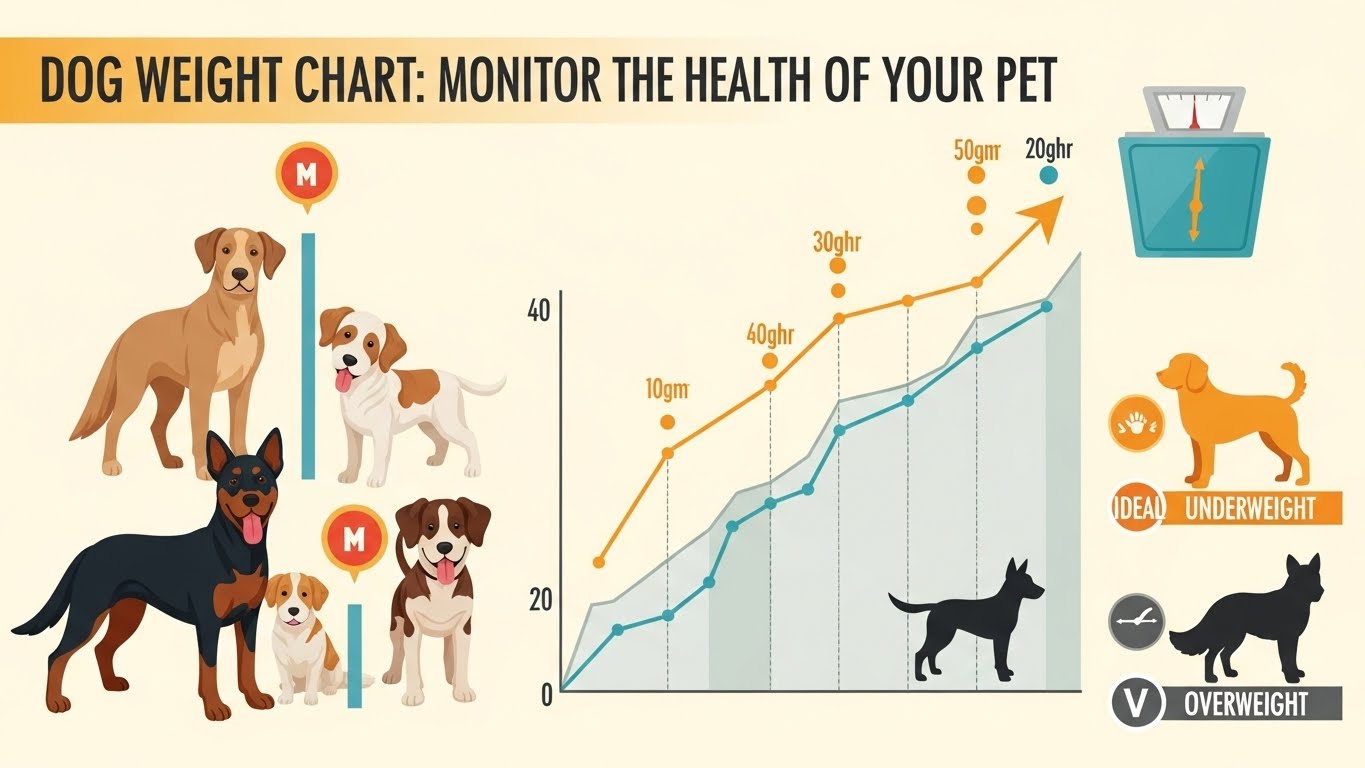
A dog weight chart is a graphical tool that presents healthy body weights for dogs based on breed, age, and body type. These charts help owners determine whether their dog is at an appropriate weight across various life stages. Dog weight charts either plot expected weight against age during puppyhood or display ideal adult breed-specific weight ranges used by paediatricians for children.
I have been using such charts for puppies and adult dogs to monitor their health care. They provide objective standards for gradual weight changes that may be overlooked by subjective observation. Breed-specific charts are usually available in veterinary offices, whereas general charts are based on dog size, such as toy, small, medium, large, and giant.
Some charts focus on body condition scoring rather than pounds to provide a more detailed evaluation. Being able to read and use these charts will help you spot weight problems early and prevent the dog from falling out of optimal health.
Different Types of Charts of Dog Weight
There are various types of dog weight charts, each with different uses depending on your needs and your dog's life stage. Puppy growth charts are used to track expected weight gain from childhood through adulthood, typically on a weekly or monthly basis. Breed-specific charts provide definitive ranges for purebred dogs based on set standards established by kennel clubs.
General size-category charts are breed-based, grouped by adult weight range: toy, small, medium, large, and giant, providing a more general set of guidelines. Unlike numbers, body condition score charts use visual and tactile scales and provide an assessment of emaciation to obesity on a scale of typically 1 to 9. Combination charts are most helpful to me because they include body condition illustrations and weight counts.
The age charts can also help ensure that the puppy's growth rate is healthy and not too rapid, which can cause joint damage, as in the case of overexcited growth. Specific charts account for gender differences, as males typically have higher weights than females of the same breed. The type of chart you choose will be based on the type of puppy or adult you have, purebred or mixed breed.
The Puppy Growth Chart: How to Read
Puppy growth charts typically plot age in weeks or months on the horizontal axis and weight on the vertical axis, with curved lines indicating expected growth patterns. Most charts show percentile lines resembling human pediatric charts, indicating that the 50th percentile represents the average, while the 10th and 90th percentiles indicate the normal range limits.
The puppy's position in the chart is less critical than tracking them at a comparable percentile. A puppy that is always at the 75th percentile is bound to grow into a larger animal, and this is good as long as the growth is not very irregular. I always instruct new puppy owners to chart their puppy's weight every 1 week within the first 6 months so they can develop their own growth curve.
Sudden jumps or plateaus can signal underlying health issues that should be examined. Large- and giant-breed charts tend to recommend slower growth than small-breed charts because rapid growth can lead to orthopaedic problems. The knowledge that various breeds have different ages of attaining adult weight: toy breeds at 8-10 months and giant breeds at 18-24 months, will make you apply these charts accordingly.
Breed-Specific Weight Standard
Breed-specific weight charts provide the best guidelines for purebred dogs because they are informed by the unique characteristics that have evolved over generations through selective breeding. The American Kennel Club and other registries publish official standards for ideal weight ranges for each breed.
For example, an adult male Labrador Retriever weighs 65-80 pounds, and a female weighs 55-70 pounds. These standards are ideal show specimens, whereas the average in the real world tends to be slightly higher. I have observed that working-line dogs often differ from show-line dogs of the same breed, even when the dogs are within 10-15 pounds. Breed clubs usually give more elaborate charts of how much weight should be expected at different ages during puppyhood.
An example is the Golden Retriever Club, which may demonstrate that males are expected to weigh 55-65 pounds at six months of age. These breeding resources are highly valuable to breeders and serious enthusiasts interested in maintaining good type. Nevertheless, owners of companion dogs must also keep in mind that it is not the level of adherence to strict standard weights that counts, but rather the overall health of the body.
Using Size Category Charts
The absence of the breed information- especially of the mixed breeds- prompts the use of size category charts as some practical alternatives, depending on the expected adult weight ranges. The toy category includes dogs that weigh less than 10 pounds; the small category (10-25 pounds), medium (25-50 pounds), large (50-90 pounds), and giant (greater than 90 pounds).
Such charts generally show the ideal weight and corresponding body dimensions, such as chest girth and length. I use them especially when the dog being adopted has an unknown origin, and you are estimating the appropriate weight. Numerous veterinary body condition scoring systems are consistent with these sizes, with target weights based on frame-size assessment.
The charts make you realise that not all 60-pound dogs are healthy, and that it all depends on whether a dog is a large-framed medium or a small-framed large breed. The size category charts are also used to determine food formulas and medication doses, as these are more closely related to size category than to specific breeds.
Body Condition Scoring Systems
Body condition score charts evaluate the appropriateness of weight based on visual and physical inspection rather than quantifying it with numeric scales. The most commonly used is a 9-point scale, where 1 means emaciation, 5 represents the perfect body, and 9 indicates extreme obesity.
These charts show how dogs are expected to appear at each score level, either on the side or above. There are descriptions of what you should feel when running your hands along its ribs, spine, and hips. When at the right weight, you must be able to feel the ribs without an extra layer of fat, you must have a waist when standing over, and tuck in the abdomen when standing beside.
I educate my clients on how to use body condition scoring, since it accounts for individual variation that is not reflected in the numbers. An athletic, muscular dog may exceed the weights in the chart yet receive a perfect five due to high body fat and poor body shape. The method is beneficial for mixed breeds and dogs with odd-shaped bodies.
Monitoring Weight at Different Stages of Life
Dogs' weight requirements and trends change substantially between the puppy and adult stages, and into old age; at each stage, the chart application must be different. The puppies should have growth charts that indicate expected developmental curves, so they can grow properly without increasing too quickly, thereby injuring their joints.
I have been around too many big-breed puppies that are fed to grow as large as possible, only to develop hip dysplasia and elbow issues at only two years old. Adult dogs tend to maintain a stable weight, and monthly weight checks are enough to detect gradual changes before they lead to issues. The elderly dogs undergo metabolic changes that require attention to weight, as activity levels decline, but in some cases, appetite may not.
Certain elderly dogs lose weight due to dental disease, reduced sense of smell and taste, or other diseases. Pregnant and lactating dogs are totally different and require a lot of weight gain as anticipated and needed. Dogs in active seasons may have higher muscle mass and weight than during rest periods. Additional skills in using weight charts include adjusting expectations to the dog's current life stage and identifying the benchmarks that apply.
Development of a Personal Weight Log
Although standard charts provide guidelines, it is best to create a weight log for your dog; it will be the most helpful tool over time and better support your dog's health. Determine weight on the same scale at the same time of day, ideally before meals, so you record a consistent weight every month. Record dietary, physical activity, health, and medication changes since they affect the weight.
I have a basic spreadsheet with the date, weight, body condition score, and notes for each dog. Taking pictures of your dog every month, from above and from the side, gives you visual records that numbers cannot capture. Gaining weight gradually within six months may not be dramatic until you put one picture against the other.
Record your dog's weight on graph paper or digitally so you can see the trend over time; a gradual upward creep will be easy to spot. Individualised follow-ups help you talk to your veterinarian about the issues at hand, based on actual data rather than your feelings. The log can be particularly beneficial when several family members are responsible for feeding the dog, and all are aware of the dog's current state and objectives.
Typical Charting Errors
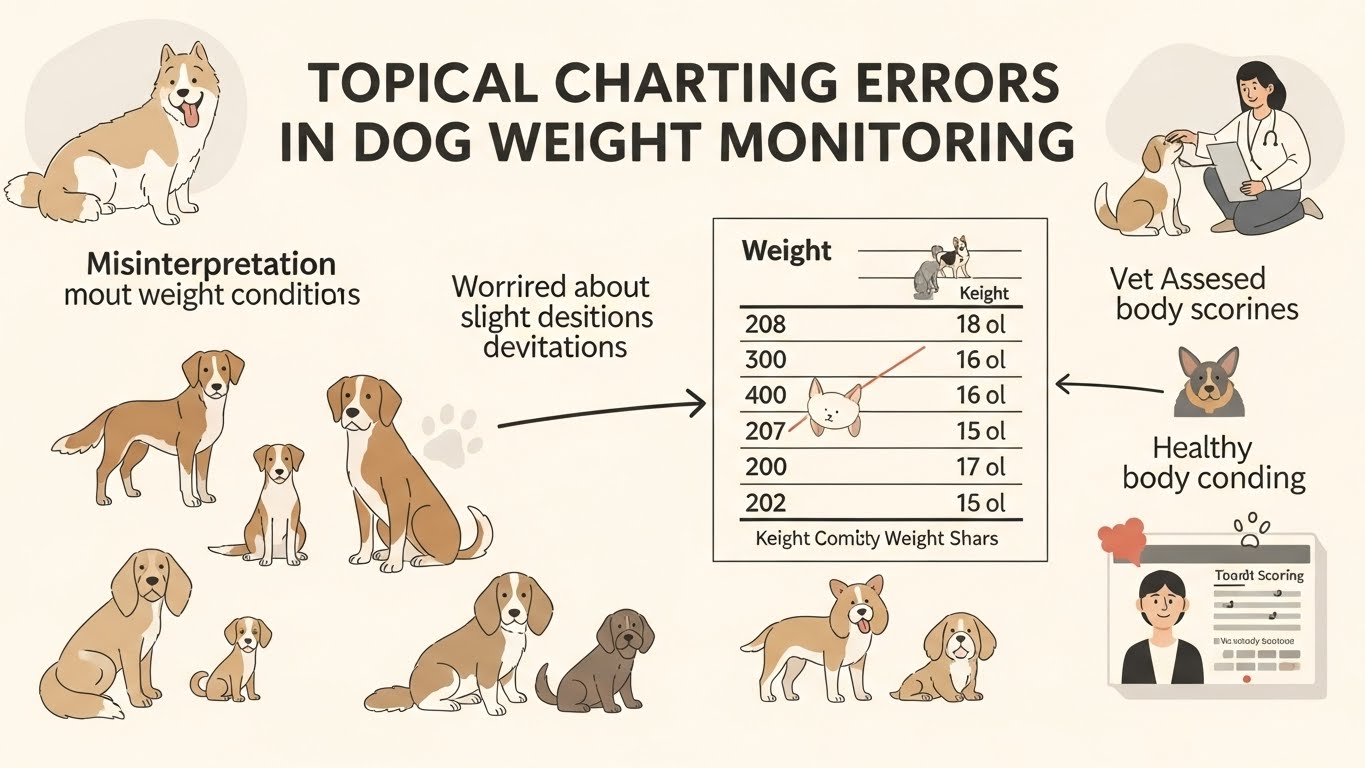
The most common pitfalls many dog owners make when using weight charts are predictable: they weaken them as health tools. The most prevalent fault is treating chart weights as strict rules rather than guidelines whose interpretation should be made on a case-by-case basis. I have encountered owners who were panicked because their healthy dog was three pounds over the upper limit listed in the chart, even when it was in excellent body condition.
The other error is related to the lack of regular weighing- it is done once or twice a year at the veterinary clinic, and it overlooks the gradual change that would be tracked by monthly weighing. Some rely solely on charts and disregard body condition, resulting in dogs reaching target weights but being overweight and lacking muscle.
There is also a problem with using incorrect charts, such as assigning a small-breed growth rate to large-breed puppies, or vice versa. Most owners lose sight of the fact that charts indicate that lean, fit dogs are slender, and that by comparing your inactive pet to that of a working dog, you are setting yourself unrealistic goals. Ignorance of personal differences can be caused by heredity, by nature, or by her level of activity, and this can create a groundless concern or complacency.
The Time to Visit Your Veterinarian
Although weight charts are helpful for at-home monitoring, there are cases where professional veterinary care is needed and cannot be provided by charts alone. A loss of more than 10 per cent of body weight in a week is cause for alarm, as it is usually a sign of severe disease. On the other hand, increasing weight fast without dietary alterations may be an indication of diseases such as hypothyroidism or Cushing's disease.
Puppies that fall off their growth curves or develop too rapidly should be reassessed to avoid developmental issues. I always recommend taking your dog to the vet when his weight does not reflect his body condition. In some cases, being underweight despite proper feeding may indicate parasites or malabsorption. Dogs that appear to remain hungry despite not gaining weight may have metabolic diseases that require diagnosis.
Elderly dogs that are skinny despite a healthy appetite usually require dental disease screening, as well as kidney or cancer screening. Body composition analysis, blood tests, and physical examination cannot be performed at home; your veterinarian can do them. They will help you set realistic weight goals based on your dog's frame, muscle mass, and health status.
Digital Tools and Apps
Modern technology has brought the dog weight chart into the digital world, with applications and online platforms that provide more powerful monitoring and analysis capabilities. Smartphone apps also let you record weights alongside photos, automatically generating trend graphs over time. Breed databases with growth predictions that depend on age and weight are considered among them.
I have tried different apps, and the ones I like most let you customise your dog type rather than rely on a universal formula. Some apps are also integrated with smart pet scales that automatically weigh your dog when they stand on them, without requiring manual monitoring. Adult weight is estimated from puppy measurements, using various formulas and breed data in online calculators.
Several veterinary clinics currently offer client portals where you can view your dog's weight history in chart form across all clinic visits. Dogs also have wearable fitness devices that occasionally include weight-control capabilities, in addition to activity tracking. Although convenient, these tools are most effective when used alongside a practical body condition examination and expert veterinary advice, rather than by altogether avoiding human judgment.
Maintaining an Ideal Weight Long-Term
Using weight charts effectively means taking action when they indicate your dog has drifted from ideal, not just passively recording numbers. If charts and body condition scoring show your dog is overweight, calculate their current daily caloric intake, including all treats, table scraps, and meals.
Most owners significantly underestimate what they're actually feeding when forced to measure and record everything. Reduce portions by 10-15%, and reassess after two weeks—gradual weight loss of 1-2% of body weight per week is safe and sustainable. Increase exercise appropriate for your dog's age, breed, and physical condition, building up gradually to avoid injuries.
For underweight dogs, rule out medical causes before increasing food intake, as some conditions can cause weight loss despite adequate intake. Choose high-quality foods with appropriate calorie density for your dog's needs. Monitor weight monthly and adjust feeding as needed since requirements change with seasons, activity levels, and ageing. Remember that maintaining an ideal weight is an active, ongoing process requiring attention and adjustment, not a passive state where you feed the same amount forever regardless of results.
Frequently Asked Questions
How often should I weigh my dog?
Weigh adult dogs monthly to catch gradual changes early. Puppies benefit from weekly weighing during their first six months to accurately monitor growth patterns.
Are dog weight charts accurate for mixed breeds?
Mixed breed charts provide estimates rather than precise targets. Focus on body condition scoring and size category charts rather than breed-specific weights.
What's more important: weight or body condition score?
Body condition score typically matters more because it accounts for muscle mass and frame size, which weight alone doesn't capture effectively.
When do puppies reach their adult weight?
Small breeds typically reach adult weight by 9-12 months, medium breeds by 12-15 months, and giant breeds continue growing until 18-24 months.
Can I use human weight tracking methods for dogs?
Basic tracking principles apply, but dogs have different nutritional needs and health considerations. Use dog-specific charts and consult veterinarians rather than human weight loss approaches.
Track Your Dog's Weight Today
Use our dog weight chart tools to monitor your pet's health and maintain optimal weight throughout their life.
Try Our Calculators