Dog Food Calculator: Find the Right Portions
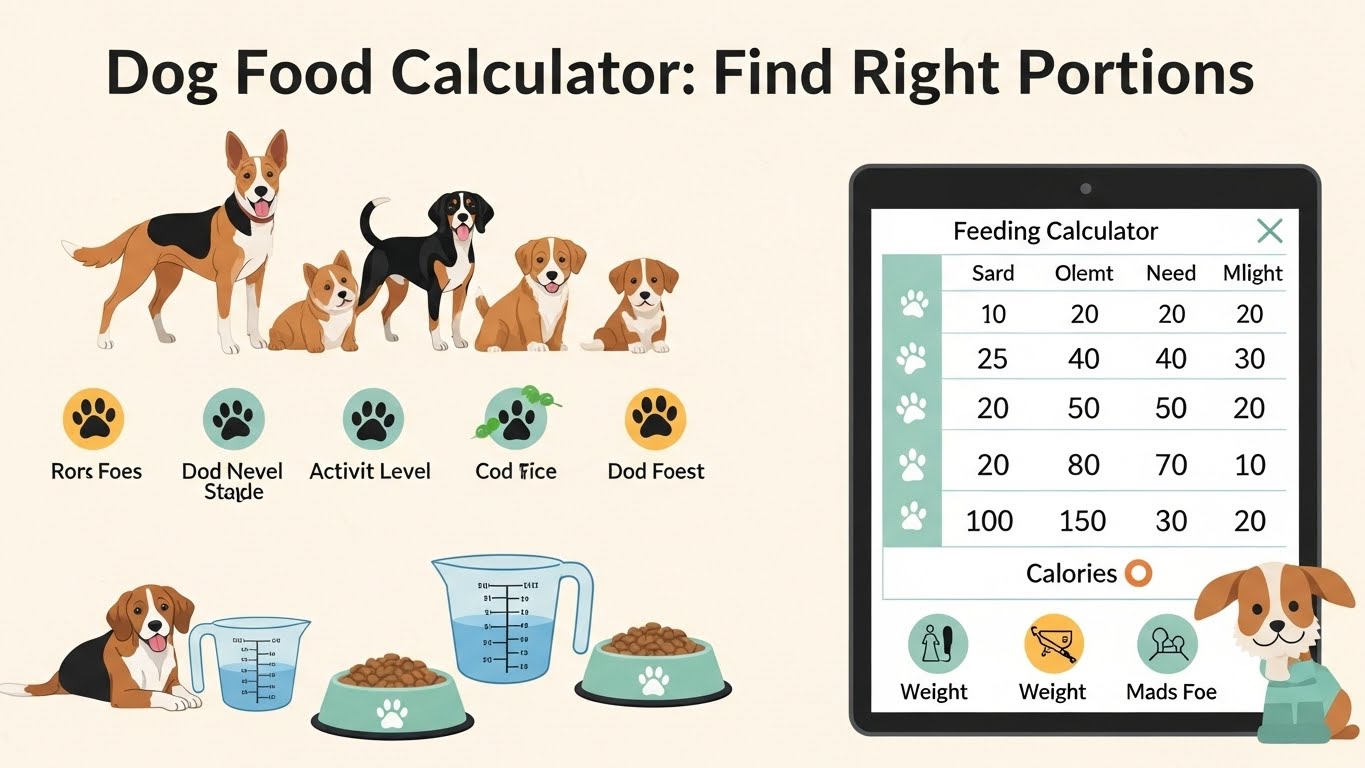
It is surprisingly challenging to feed your dog the proper amount of food, and an estimate will result in overfeeding or underfeeding. A dog food calculator removes the guesswork in portioning by calculating the weight, age, activity level, and caloric density of your dog's specific food. I have seen too many well-intentioned owners fill the bowls with food based on what seems right rather than estimating the actual needs.
The result? Almost six out of ten dogs are fat or obese, which poses some preventable health issues. On the other hand, other active dogs do not get the right amount of calories to ensure their energy levels. An effective dog food calculator provides customised feeding guidelines that account for individual differences.
These have advanced significantly, and modern calculators now account for factors such as neuter status, breed-specific metabolic rate, and even local climate. It is essential to know how to use these calculators to provide optimal nutrition.
Knowing the Caloric Requirements of Your Dog
Each dog needs a certain number of calories per day to maintain its current weight, and this varies widely among dogs. An inactive Chihuahua may only be able to consume 150 calories per day, and an active Border Collie may need to consume 1,400 calories per day. The starting value for calculating the baseline is the resting energy requirement (RER), which is the number of calories required to sustain basic bodily activity.
The calculation is: RER = 70 (kg body weight) × 0.75; however, most dog food calorie calculators perform the calculation automatically. At that point, the calculator applies a life-stage and activity multiplier. The average neutered adult dog requires 1.6 times its RER, and the intact adult dog requires 1.8 times its RER.
Depending on the workload, working dogs may need 2-5 times RER. These are the exact calculations I have observed while monitoring my dogs' weight over time as I have been implementing the calculator's advice. The point is the realisation that these are initial steps that should be observed and modified in accordance with personal reaction.
The Working of Dog Food Calculators
Calculating the quality of dog food requires several inputs to generate precise recommendations. To calculate your dog's calorie needs, you will need the dog's current weight, preferably in kilograms or pounds. Age is a factor because young, mature, and older dogs have different metabolic rates. The level of activity usually provides options such as sedentary, moderate or active.
Others will even require you to answer whether your dog is neutered, because neutering reduces caloric requirements by approximately a quarter. The calculator then requires details about your dog food, such as the brand and formula, or the number of calories per cup listed on the bag. This is important because foods vary widely in caloric content.
One cup of a particular brand may contain 300 calories, whereas a cup of another brand may contain 450 calories. The calculator breaks down the overall daily calorie requirements of your dog and allocates them to the caloric content of the food to know what to feed your dog. Better calculators are also more considerate of treats, asking what portion of daily calories is allocated to treats and revising meal portions accordingly.
Types of Calculators That Are Available
There are different types of dog food calculators, each with its own benefits. Simple online calculators provide an approximate estimate with minimal input: only weight and activity level. They are suitable for delivering simple needs but lack accuracy. Detailed web-based, computerised veterinary school or professional organisation calculators include comprehensive questions and extensive results across various feeding scenarios.
I especially have faith in calculators used in institutions such as Ohio State University's veterinary school, since they are not calculated using marketing tactics. Numerous high-end dog food companies offer online calculators, but they are often biased toward recommending larger portions to increase sales.
Smartphone apps let you save your dog's profile and easily re-enter it when circumstances change. Specific applications also integrate with activity trackers to automatically adjust feeding based on exercise data. More and more veterinary practice management systems have built-in calculators that your vet may utilise on their visits to make printed feeding plans.
Making Allowances for Life Stages
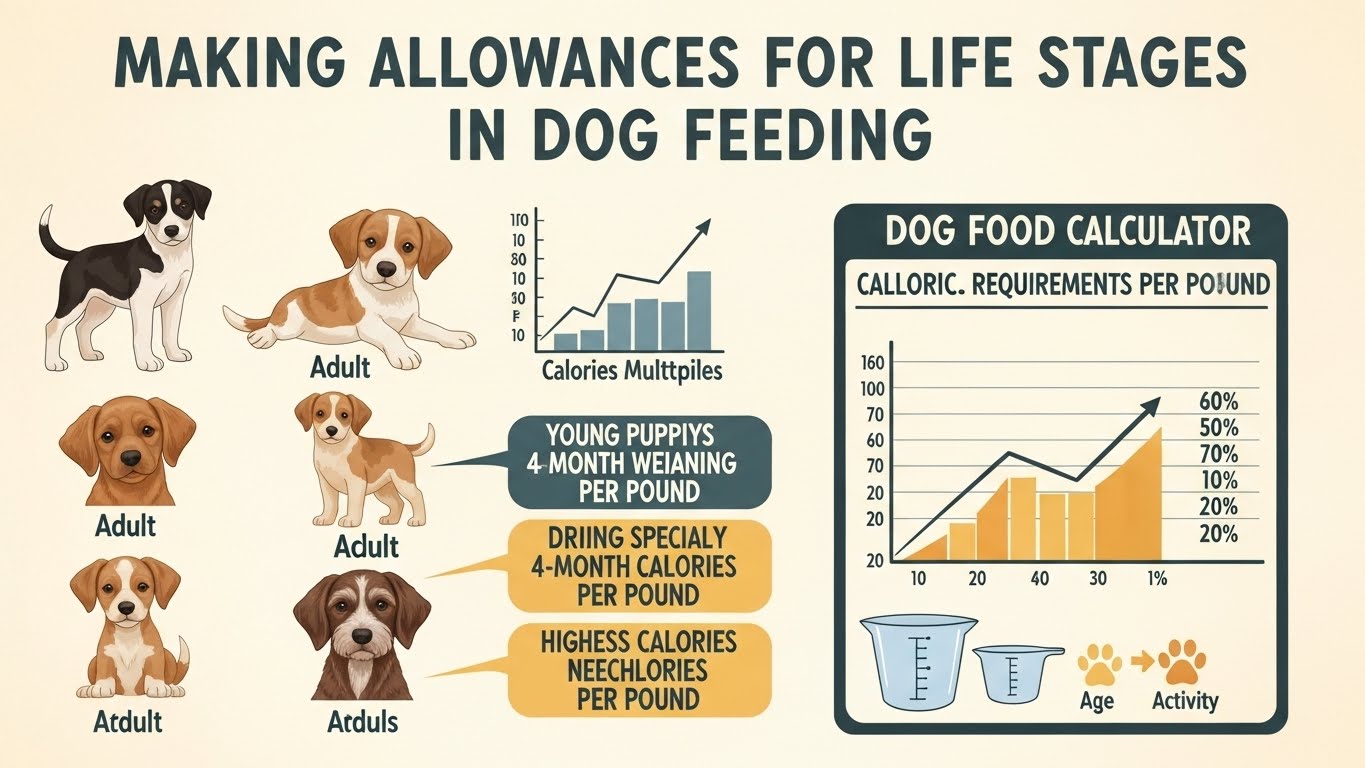
Nutritional requirements of puppies are radically different from those of adult dogs, and dog food calculators should consider them. Young puppies have higher caloric requirements per pound of body weight than adults because they are still growing and accumulating tissues, not merely supporting themselves. The multiplier, however, varies with age. Puppies, which are very young (during the four-month weaning period), require the highest per-pound calorie intake relative to their size, and this need declines gradually as growth decelerates.
I have raised several puppies using the calculator guidelines and revised them monthly as the puppies developed. Big breed puppies pose particular challenges - they should be fed fewer calories to ensure they do not grow too fast to burden their growing bones. Most calculators have large-breed puppy settings.
The caloric requirement of elderly dogs is usually fifteen to twenty per cent lower than that of adults due to the reduction in metabolic rate and activity. Mating and nursing dogs require extraordinarily high demands, and at times, three times the standard requirement at high lactation levels. Quality calculators offer options for all these life stages.
Adjustment to Level of Activity
Exercise intensity significantly affects caloric requirements, yet it is often underestimated. The owner's definition of the word "active" differs widely from the definition of "high activity". The dog that takes 30 minutes a day is moderately active, not highly active. I will use the highly active category with dogs who do more than an hour of exercise a day - I will consider agility competitors, working ranch dogs or bicycle running dogs.
Sedentary dogs spend most of their time lying around and go outside only to use the bathroom. Most household pets are moderate. Multipliers of 1.4-1.6 are usually used as the method of calculating dog food when the dog is sedentary, 1.6-1.8 when moderate, and 2.0-5.0 when highly active.
The seasonal fluctuation is essential. My dogs are more active in cool weather and require approximately 10% more food in winter than in summer. Other sophisticated calculators allow you to make these adjustments. It is essential to evaluate the level of activity honestly - underestimating results in being overweight.
Knowing the Caloric Density of Food
Even the same volume of different dog foods can have significantly different calorie counts, which makes generic feeding charts pretty worthless. That is why dog food calculators require the specific caloric value of the food that you have chosen. Higher-meat, premium foods usually contain more calories per cup than grain-intensive, low-cost foods.
I have observed that foods contain 250 to 500 calories per cup. The bag includes the caloric density, which is typically listed in the guaranteed analysis section or on the manufacturer's website. It is presented in terms of kcal/cup or kcal/kg. In the absence of this information, a dog food calculator cannot give the proper proportions.
Other calculators have preprogrammed databases of common foods with calorie counts, which are handy but should be checked against your own bag, as the formula can vary. It is more difficult to measure the moisture content of wet food because of its high moisture. A 13-ounce can may contain only 300 calories, since 75% is water.
Include Treats and Extras
One of the most common feeding errors is failing to determine meal portions accurately and omitting treats, training rewards, and table scraps. Such extras could easily add twenty to thirty per cent of the amount of calories consumed daily. I was taught this by the fact that my dog remained perfectly trimmed despite the calculated amount of food, and then, with increasing doses of intensive training based on giving out treats, actually gained weight without decreasing food intake.
Dog food calculators are designed to answer the question: What percentage of calories should be allocated to treats to reduce the amount of food in the diet? The general guideline is to preserve treats to less than one-tenth of daily calories. A dog needs 800 calories per day, but it only has treats with 80 calories each, which is about six medium-sized biscuits.
The problem of training treats is especially complex because you can consume dozens of them in a single training session. I replaced large, high-calorie training snacks with small, low-calorie ones and vegetables such as carrots. Specific calculators allow one to enter specific treats and their calorie content to account for them accurately.
When to Tweak Calculator Recommendations
Dog food calculators are not prescriptions which cannot be changed. Depending on your dog's reaction, you will need to vary. When introducing a new portion, weigh your dog after every two weeks. If they lose weight, increase portions by 10%. If they make a profit, drop by a tenth. It is not about absolute weight, but about body condition: you must be able to feel the ribs without straining; there must be a waist when looking up and down; and you must be able to see an abdominal tuck.
I have had dogs that required fifteen per cent less than calculators recommended, and dogs that required ten per cent more, even though they were of the same breed. The metabolism of individuals differs greatly. Adjust proportions by season when activity changes.
Health issues also influence needs, as hypothyroid pets require fewer calories, and those that are ill may require more. The demands of pregnancy and nursing are increasing rapidly. Using a calculator is a knowledgeable starting point, but adequate feeding needs to be monitored and changed. You will learn more about your particular dog than a calculator after a matter of a few months of observation.
Mistakes to Watch Out For
I observed that people make predictable mistakes when they invest in dog food calculators that compromise accuracy. The most common issue is miscalculating weight when using calculators in units other than the base unit. This is to ensure you always use pounds or kilograms. The other error is the inability to measure food volume accurately.
A cup ought to be a real measuring cup, not a haphazard scoop mounted high. I weigh my food on a kitchen scale in grams for absolute precision. Most individuals choose an activity that is not appropriate for their dog, and they overestimate their dog's activity level. This will avoid excessive feeding, as one is honest. Leaving treats out of consideration contributes to a calorie surplus.
Other owners will enter their dog's weight when it is already overweight, and the calculator will suggest food quantities to maintain an unhealthy status quo. Instead, find the optimal weight and portion the amounts accordingly. When situations evolve, it is dangerous not to recalculate what is suitable for a two-year-old dog, but it can be too much for an eight-year-old dog.
Special Dietary Consideration Calculators
The standard dog food calculators are used under the assumption that you are feeding a regular maintenance food, but the dogs that suffer from health conditions require a special calculation. Prescription diet computers consider various caloric content and feeding regimens of therapeutic foods. The calculators used to achieve weight loss generate caloric deficits to attain safe and gradual weight loss, commonly, fifteen to twenty-five per cent of the maintenance level.
I have been doing this effectively on overweight dogs, achieving a desired one to two per cent weight loss per week. Homemade diets require more complex calculators because you are not only calculating calories but also ensuring nutritional completeness. The latter usually involves discussion with a veterinary nutritionist.
The performance dog calculators take into account the special requirements of various types of work - sledge dogs require different nutrition than detection dogs. The growth rate is regulated in large-breed puppy calculators to safeguard joint development. Both specialised calculators address nutritional needs that general calculators fail to put into proper perspective.
Portion Control Based on Calculator Data
After estimating how much food your dog should eat per day, portion control is essential. I make two meals for adult dogs and three for puppies. The consistency is vital - feed at a uniform time of the day in the same quantity. Free-feeding with food being made continuously means that you cannot control the amount of food you eat, and almost ensures weight issues. Buy a nice measuring cup or a kitchen scale.
You should weigh your dog daily in the morning and place it in meal-sized containers. This avoids the risk of overeating in the late afternoon. Others take a little less than they are supposed to at mealtimes and end up with a few bites of training snacks at other times of the day.
This leaves the correct total and offers training opportunities. I maintain a record of measured portions, mapped to actual weight, to determine which modifications are effective. Automated feeders can provide accurate amounts when you are away or ride odd hours, although I prefer the experience of hand-feeding.
Monitoring and Recalculation over the Long-Term
One does not use a dog food calculator just once, but as a continuous process. Recompute when there are significant changes, such as a change in weight (over 5%), a change in activity level, a change in the type of food consumed with different energy content, or when a new stage of life is reached.
I recalculate after every quarter in adult dogs and after every month in puppies, as their needs can change very quickly. The elderly dogs may require recalculation every few months due to a slowing metabolism and reduced activity. Monitor the dog's weight and physical condition regularly, and compare the observed outcomes with what you would expect based on the current portions.
If the weight starts creeping up even after following the calculator's instructions, reduce portion sizes or exercise more. Recalculation should be performed in cases of digestive problems, changes in medication, and health complications. The calculator is a valuable tool throughout the dog's life, helping you adjust feeding to maintain optimal weight and health at every stage.
Frequently Asked Questions
How accurate are dog food calculators?
Dog food calculators provide a solid starting point based on scientific formulas, but individual dogs may need 10-15% more or less than calculated. Monitor your dog's weight and body condition, then adjust portions accordingly. Calculators from veterinary institutions tend to be more accurate than those from pet food companies.
How often should I recalculate my dog's food portions?
Recalculate quarterly for adult dogs and monthly for puppies. Also recalculate when there are significant changes such as weight changes over 5%, activity level changes, switching to a different food, or entering a new life stage like senior years.
Should I include treats in the calculator?
Yes, absolutely. Treats can add 20-30% of daily calories if not accounted for. Keep treats to less than 10% of daily calories and reduce meal portions accordingly. Quality calculators have options to factor in treat calories.
Why is my dog gaining weight despite following calculator recommendations?
Common reasons include overestimating activity level, not measuring food accurately, forgetting to count treats and table scraps, or individual metabolic differences. Try reducing portions by 10% and reassess after two weeks.
Do puppies need different calculator settings than adult dogs?
Yes, puppies have much higher caloric needs per pound of body weight due to growth. Quality calculators have specific puppy settings that account for age and expected adult size. Large breed puppies need controlled growth to protect developing joints.
Calculate Your Dog's Perfect Portions Today
Use our comprehensive dog food calculator to determine the right feeding amounts for your pet's optimal health.
Try Our Calculators