Dog Age Calculator: The Truth About Your Pet's Real Age
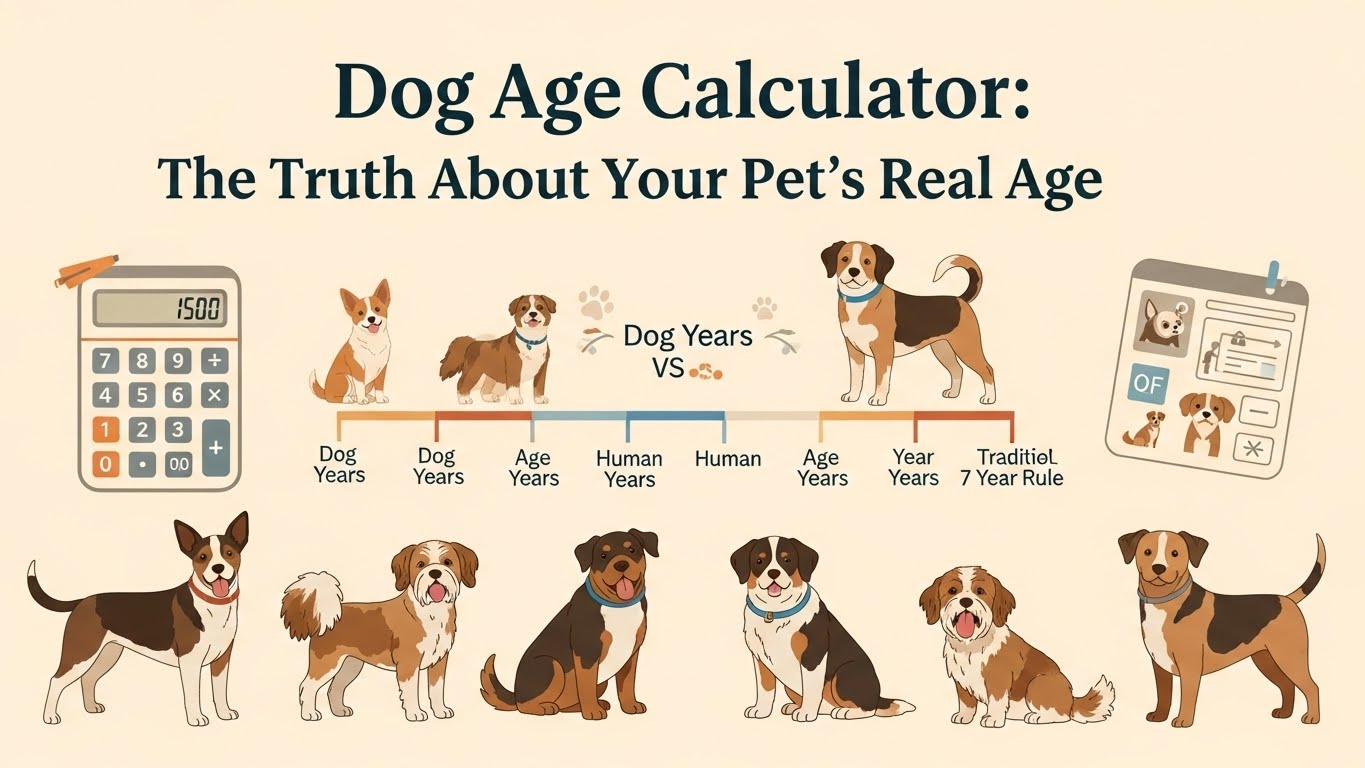
Understanding Your Dog's Real Age
My grandmother used to tell me, as a child, that I should multiply my dog's age by seven to find its human equivalent. Our family Labrador reached her tenth birthday, so we celebrated what we assumed was her seventieth birthday with extra treats and a new bed.
It made sense at the time, but now that I have been working with veterinarians for 15 years and have studied dog health, I have realized that this simple calculation has failed. The science of aging in dogs is much more complicated and intriguing than a simple multiplication table may seem.
A reliable dog age calculator takes into account factors our grandparents were not even aware of. The size of the breed, genetics, and developmental stages are important factors that help us understand how our pets age, compared with humans. Knowing the exact biological age of your dog is not just trivia, because it has a direct effect on the type of healthcare you give your dog, the kind of food you feed it, and the amount of activity appropriate for your pet.
Why the Seven-Year Rule Never Made Sense
The rule of seven years was based on an approximate average lifespan. The average human life is approximately seventy years, whereas the average life of a dog is approximately ten years; therefore, the ratio is seven to one. But every person who has ever raised a puppy is aware that this mathematics collapses at once.
A dog, at the age of one year, can reproduce, hunt and survive on its own, but a seven-year-old child definitely cannot. Dogs are highly active during the first two years of their life cycle, then become progressively slower in their middle years, before increasing decline in their senior years.
Take this realistic case: my neighbor's Great Dane at five years old already showed signs of arthritis and a grey muzzle, whereas my Jack Russell Terrier at the same age was quite active and still puppy-like. The two dogs would be 35 years old in human years under the seven-year rule, yet could not be more physically different. This finding prompted scientists to develop better methods for determining dogs' ages.
The Science of Modern Dog Age Calculators
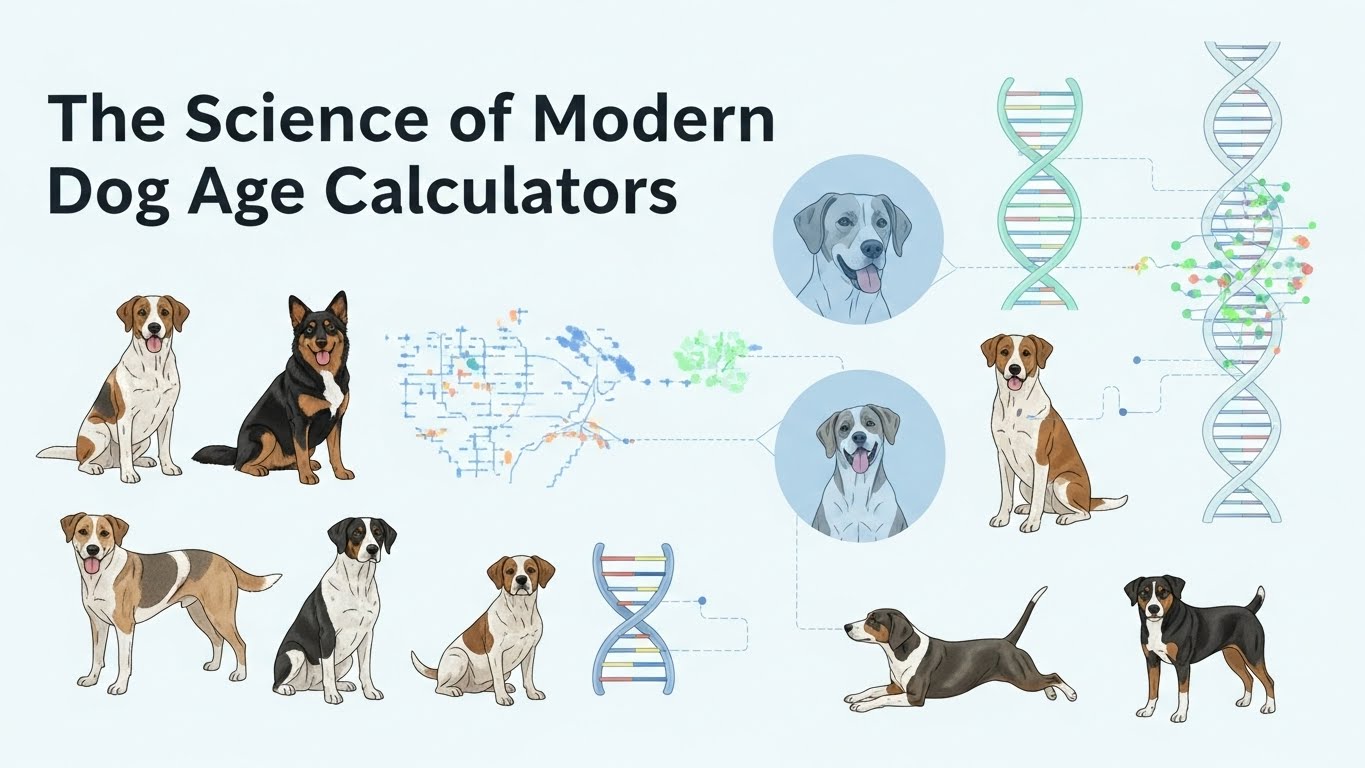
Recent research has revolutionized how we view the aging of dogs. A study published at the University of California, San Diego, examined DNA methylation patterns in dogs and humans. Methylation changes that occur predictably with aging across cells act as a biological clock in our genes. Scientists have discovered that dogs age extremely quickly in their first year, reaching about 30 human years.
The equation derived from this study uses logarithmic mathematics rather than simple multiplication. Although the exact mathematics may appear complex, modern dog age calculators have made these results simple to use. A 2-year-old dog is comparable to a 42-year-old human, and further aging is about 4 human years per dog year for medium-sized breeds.
That is why puppies grow so fast in the first months of life, adapting from helpless newborns to active adolescents within several weeks. This rapid early development explains the dramatic maturation we observe in young dogs.
Why Breed Size Matters More Than You Think
An important variable often overlooked by simple calculators is breed size. Small dogs always live longer than their larger counterparts, and in some cases, the difference is quite significant. A Chihuahua can live eighteen years, whereas a Great Dane can hardly live beyond eight or nine years.
This is referred to as the size-lifespan trade-off and is observed in most species. However, it seems especially acute in domesticated dogs due to extreme size changes associated with selective breeding. Large-breed dogs age at a faster cellular rate. Their organs are strained more, their joints must carry more weight, and their hearts must pump blood through larger bodies.
When you enter your pet's weight or breed type into a dog age calculator, you get widely varying results. My friend's four-year-old Irish Wolfhound worked out to around fifty human years, whilst my mother's fourteen-year-old Pomeranian equated to around sixty-eight human years. Such breed-specific aging patterns should be taken into account to ensure accurate calculations.
Practical Applications in Pet Ownership
Knowing your dog's actual biological age can help you make the right decisions for your dog. Veterinarians use age calculations to determine appropriate screening tests, vaccination timelines, and diet modifications. A seven-year-old German Shepherd may need health screenings, whereas a seven-year-old Maltese may not require those tests for several more years.
Exercise recommendations also vary based on accurate age assessment. During vigorous exercise, an older dog is subjected to undue stress and may sustain injuries. Meanwhile, lack of exercise in a middle-aged dog leads to obesity and behavioral disorders.
I have seen dozens of owners who limit their healthy eight-year-old small breeds to gentle walks but do not realize they need more exercise. Conversely, other owners push their large-breed dogs to exhaustion without realizing that their four-year-old is technically in middle age.
Limitations of Any Dog Age Calculator
No calculator with scientific support can yield precise results for every individual dog. Ages are influenced by genetics, nutrition, medical history, and environment. A dog that is fed well and taken to the vet regularly will age gracefully compared to a dog of the same breed in poor condition.
Mixed-breed dogs are more challenging to predict because their genetic composition mixes aging trends from several breeds in unpredictable ways. I always suggest that pet owners use calculators as approximations instead of conclusive evaluations.
Your veterinarian's clinical assessment of your dog, covering the condition of teeth, eyes, joints, and organ function, provides much more accurate information than an internet-based tool. Physical manifestations of age include grey fur, loss of mobility, vision, and hearing, which occur on personal schedules that calculators cannot determine. Every calculator result should be used as a starting point for conversation with your vet, not as a diagnosis.
Making the Best of Each Life Stage
However you calculate your dog's age, it is essential to understand the stage of life your dog is in to care for it accordingly. Puppies are energetic and require extensive socialization and patience throughout their training. Teenage dogs need mental challenges and clear boundaries, as they tend to push limits.
Adult dogs perform well when they maintain routines and regular exercise. Elderly dogs benefit from joint supplements, comfortable bedding, and adjusted activity levels that fit their changing abilities.
My personal strategy is to conduct an annual review using various dog age calculators and monitor my pet's condition regularly. When my twelve-year-old Beagle began hesitating to jump onto furniture, I did not need a calculator to tell me she was aging. Nevertheless, knowing she was about 65 in human years helped me understand her needs and adjust the home environment. Stairs were replaced with ramps, thin cushions with orthopedic beds, and long hiking trips with shorter, more frequent walks.
FAQs
How accurate are online dog age calculators?
Most reputable calculators provide reasonable estimates based on current scientific knowledge. However, individual differences mean that outcomes should inform, not dictate, medical decisions. Your veterinarian's evaluation of your dog's health status remains essential.
Does neutering or spaying influence how dogs age?
Some studies indicate that altered dogs may age slightly differently due to hormonal variations. However, the health benefits of spaying and neutering tend to outweigh any negligible impact on longevity and aging calculations.
At what age is a dog considered elderly?
This varies significantly by size. Small breeds are generally seniors at about 10-12 years, medium breeds at about 8-10 years, and large or giant breeds at about 5-7 years.
Why do small pets live longer than large dogs?
Scientists believe that large dogs age faster due to their high growth rate and cellular stress. They subject their bodies to greater wear and tear over shorter periods than smaller breeds.
Should I adjust my dog's diet based on its calculated age?
You should adjust your dog's diet based on your dog's physical condition and your veterinarian's recommendations, not just calculator results. However, knowing the approximate biological age can guide discussions with your vet about proper nutrition.
Ready to Calculate Your Dog's Real Age?
Use our scientifically-based dog age calculator to discover your pet's true biological age and provide better care.
Try Our Calculator