Daily Dog Food Intake: Complete Feeding Guide
Learning the Basics of Daily Dog Food Intake
A dog needs its daily food intake, which is one of the most crucial responsibilities of pet ownership. I have heard too many stories of dogs with health conditions due to obesity or a lack of vitamins and minerals, just because their owners did not know how to feed them. Food does not simply mean filling your dog's bowl every day; it means providing the exact nutrition they need based on their individual traits.
The amount is too large to believe, and it depends heavily on the animal's size, age, activity level, metabolism, and even the food you feed them. The daily intake of a working Border Collie cannot possibly be the same as that of the senior Pug sitting on the couch.
When it comes to working with dogs, I have found over the years that there is no single answer; there are many ways to determine what is right for your particular dog. This manual will help you set the correct daily consumption and when to adjust it.
Beginning With The Weight of Your Dog
There is a weight that forms the basis of the estimation of the daily intake of dog food. Your dog will perform best based on its target weight, not its current weight, if it is overweight or underweight. Their current weight is ideal for a healthy weight dog. Small dogs (under 20 pounds) do not require many calories (typically 40 per pound per day).
Medium-sized dogs, 20-50 pounds, have an approximate need of 30 calories per pound. Large dogs weighing more than 50 pounds require approximately 20-25 calories per pound, and giant breeds tend to require slightly fewer calories per pound because their metabolism is slower. I would always stress that they are points of departure.
Theoretically, a 30-pound Beagle requires 900 calories per day; however, your Beagle's specific metabolism may need 750 or 1,050 calories. It can only be determined by starting with precomputed values, tracking the body's condition over a few weeks, and making adjustments.
The Requirements of Age Daily Change
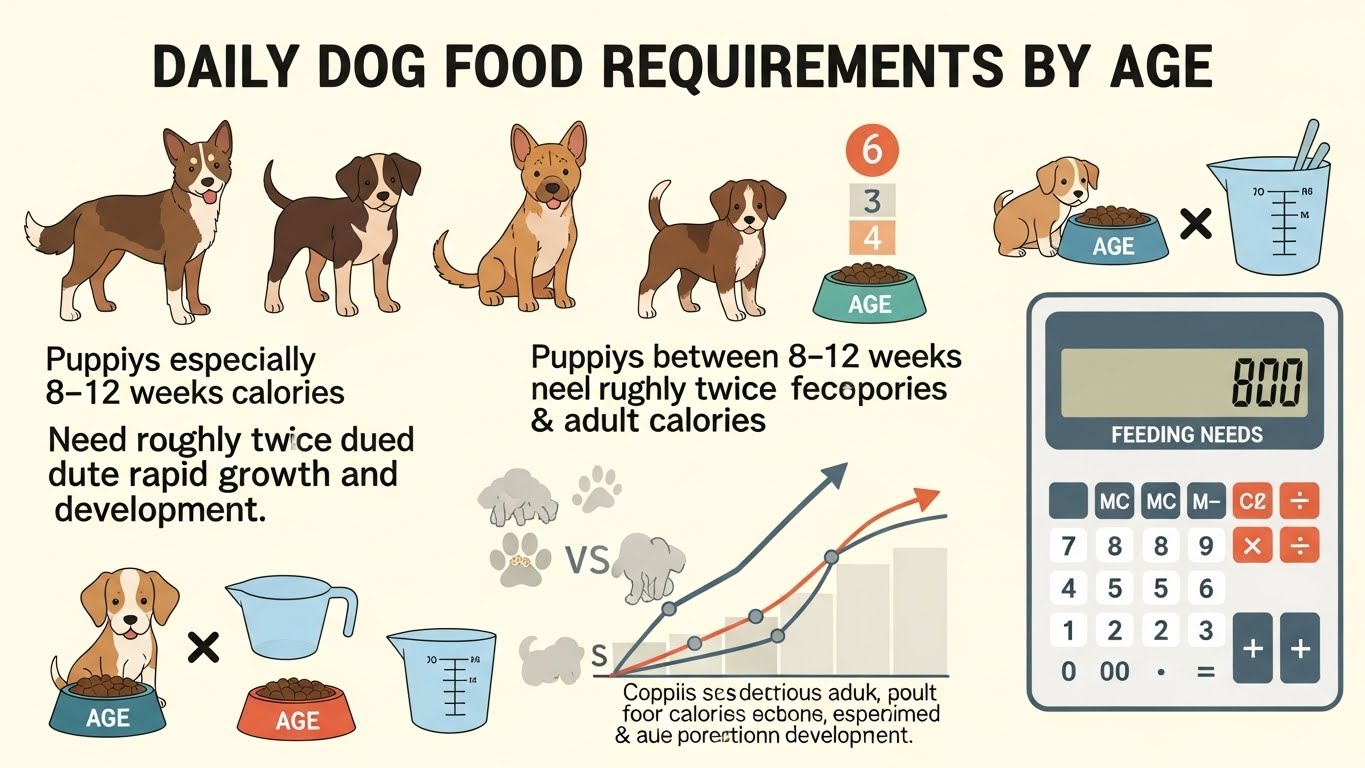
The effects of age on daily dog food intake are pronounced, yet many owners do not fully account for them. Puppies require approximately twice the caloric intake of adults because they are developing their entire body systems. I have lifted many litters and seen puppies eat horrible quantities of food considering their size. They are eating machines between 8 and 12 weeks.
Their consumption also declines as they grow up, reaching an adult maintenance level of about 12-18 months, which is influenced by breed size. Dog intake remains relatively stable over the years, unless there are significant lifestyle changes. Next is the senior transition, typically around age 7 in large breeds and 9-10 in small dogs.
Older dogs require no more than 20 per cent of the daily intake of vigorous adults due to a slower metabolism and natural loss of activity. I had reduced the number of all my dogs whenever they became old. The inability to decrease the consumption of the elderly is a significant reason behind geriatric obesity that worsens arthritis and other ageing-related ailments.
Adjustment to the Levels of Activity
The most variable factor may be activity level, as it can influence daily dog food intake. A poodle kept in a house and a poodle who competes in the agility field may require 40% different calorie requirements. Assessing activity levels is an essential but difficult task for many owners. Sedentary refers to little activity besides getting up to go to the toilet once in a while- this is what can be said of most contemporary pets.
Moderate exercise consists of 30-60 minutes of walking or casual play. Active dogs receive 1-2 hours of vigorous exercise, such as running, swimming, or intensive fetch. Very active or working dogs are physically active and do a physically taxing work over several hours - consider hunting dogs, herding dogs actually working livestock, or sledge dogs.
I am multiplying the baseline by factors of activities: 1.0 (sedentary), 1.2 (moderately active), 1.4-1.6 (active), and 1.8-2.0 (very active). There are challenges for weekend warriors. If your dog elevates on Saturdays and takes the whole week off, use moderate instead of active.
Meal Frequency/Daily Total
Although the amount of nutrition that is provided by your daily dog food consumption may be determined, the way you split the amount of food you consume considerably affects your digestion, behaviour, and health. Most adult dogs are fed twice daily, with the total number of meals split between morning and evening, each about 12 hours apart. This plan will prevent excessive hunger, stabilise blood sugar, and reduce stomach upset.
Eating in one sitting can cause dogs to eat too fast, which may lead to bloat in large and deep-chested breeds. I have tried different feeding schedules, and twice-daily feeding is the most effective for most dogs. Others have smaller three-meal portions, which is helpful for those with sensitive stomachs or prone to vomiting after eating.
Puppies require more frequent feeding: four times daily until 12 weeks, three times daily until 6 months, then twice daily. Most dogs do not respond to free-feeding the full amount of food per day, as they end up overeating and becoming obese. I will only recommend it to those dogs that have shown good self-control.
Among the Changes in Food Quality are the Amount
All dog foods cannot be considered the same in the determination of day-to-day consumption. High-quality protein foods that contain very little filler are higher in calories and easier to digest than low-cost alternatives. I have alternated the dog food quality and had to increase or decrease portions by 25-30% to maintain the same weight.
A food whose first ingredient is actual meat and whose calorie content per cup is 450 kcal needs smaller portions than a food that contains a lot of grain but has 320 kcal per cup. It is always important to check the caloric content of the specific food listed on the package when calculating daily intake. One food may contain two cups of another food with the same nutritional value.
Another thing I have observed is that high-quality foods generate less waste, literally. Dogs digest more nutrients, which can lead to small, hard stools. High-fibre foods must be eaten in larger amounts each day to meet nutritional requirements, and dogs often empty their bladders because they are dealing with more indigestible food.
Expenses Regarding Accounting
One of the most critical errors in daily dog feeding management is failing to count all edible items toward the total. I constantly come across dogs that are the ideal size to eat but too fat because owners never consider training treats, dental chews, bully sticks, table scraps, and other extras. Treats recommended by veterinary nutritionists should be no more than 10 per cent of daily intake.
Extras may account for no more than 10 per cent of total daily intake. Assuming you have a dog that requires 800 calories per day, the most you can have from anything other than actual meals is 80 calories, which is about 8-10 small training treats or a large bully stick. I would do this in two ways, depending on the circumstance.
To dogs that receive minimal rewards, I do not change meal portions. For dogs undergoing intensive training or receiving daily chews, I will calculate the treat calories and reduce meal portions accordingly. Most owners are unaware that a medium milk bone contains just 40 calories, or that even sharing a piece of dinner chicken can add 100 or more calories in a short time.
Checking and Regulating the Intake
The first amount of dog food you feed is not the end; constant observation will inform you of the suitability of the amounts you feed your particular dog. I measure my weight monthly and evaluate my body condition weekly. You need to press the ribs lightly with your fingers, but no more than that, and not see them sticking out (except in naturally thin-bodied breeds such as Greyhounds). At the top, one can see a distinct waist behind the ribs.
On the side, the belly is supposed to curl upwards between the chest and the hind legs. If your dog becomes unconditioned over time, you may notice, over the weeks, that your dog has been losing condition: ribs are more visible, energy levels are dropping, and the coat is becoming coarse.
Every time you feed your dog, add 10 per cent to the amount fed and review after two weeks. If the weight gain is in the ribs that are harder to touch, or the waist is lost, eat 10-15% less. Some dogs remain on calculated amounts, while others require a 20% or higher improvement margin. Maintain basic records of mass, proportion, size, and observations. This information helps identify trends before they escalate into issues.
Daily Intake Varies by Season
One aspect most dog owners overlook is that daily food intake may need to change with the season. Dogs that spend much time outdoors in winter burn more calories to keep their bodies warm. I also add 10-15% to my dogs' portions during the cold months when they spend much time outdoors. On the contrary, in hot summer seasons, other dogs are naturally less hungry and may require minor adjustments.
The level of activity also tends to vary with the season. A dog that runs in the summer season when it is swimming with the dog, and when walking with the dog in winter, will have different needs in the season, even though the time of day is the same. During active months, such as fall and winter hunting, when hunting dogs are at their most vigorous, intake must increase dramatically; during the off-season, intake must decrease dramatically.
I have dealt with a few sporting dogs whose daily food doubles during the hunting season. The trick here is to identify these patterns early and make proactive adjustments, rather than letting the weight changes take major turns. Even minor corrections made in time are better than big corrections made later.
Health Special Instructions
Standard daily food intake calculations for dogs do not account for health conditions. Diabetic dogs require specific, regular portions timed relative to insulin administration; a veterinarian will provide exact amounts of food that may be adjusted from the calculated conventional amounts. Opening up to 20-30 per cent is needed by hypothyroid dogs compared to regular recommendations because thyroid hormone controls metabolism.
I have worked with several hypothyroid dogs that were able to lose weight on tiny amounts of food. Special diets and calorie levels with varying protein levels are usually required for dogs with kidney disease. The patients who are being treated with cancer may at times require higher levels of intake to sustain weight.
During pregnancy, pregnant dogs require a slow increase in intake and new mothers require an enormous amount, as much as 50 per cent in periods of maximum lactation. I had a mother who was a nurse with a giant litter who required more than three times her usual consumption. You never want to follow general rules when deciding what your dog should eat; always consult your veterinarian about proper daily intake if your dog has known health conditions.
Switching to New Daily Amounts
Gradual changes are most effective when modifying your dog's daily food intake, whether reducing or increasing it. Sharps can cause digestive distress, hunger, anxiety, or food rejection. When you are overeating and need to cut your intake by 30 per cent, do not do it in one night. I cut portions by 1/10 every 3-5 days until I reach my target. This allows the dog's metabolism and digestive system time to develop.
Watch for signs that you are becoming too hungry, such as preoccupation with finding food, guarding bowls, or scavenging, as this may indicate you are reducing too fast. Similar gradual changes in intake, when increasing intake, inhibit sudden increases in diarrhoea and vomiting.
If changing food brands in part, one should change the food first for 7-10 days, then proceed with portions. Attempting to modify both simultaneously makes it impossible to determine which aspect of the modification caused any issues. I constantly remind owners that transitions should be introduced gradually to avoid problems and achieve superior long-term results, rather than rushing to implement changes.
Typical Everyday Dietary Mistakes
I have made some common mistakes that owners have observed when feeding their dogs daily for years. The most prevalent issue is adhering to bag advice without considering personal needs; those rules tend to be quite strict and do not account for pets that are not very active. Another common mistake is estimating portions instead of measuring.
What you believe is one cup could be 1.5 cups, and you could overfeed by half. I am not using random containers as actual measuring cups. Eating more or less every day, depending on convenience, instead of maintaining a consistent intake disorients metabolism and no longer allows one to determine whether portions are appropriate.
Free feeding and thinking you are in control of what you take are not adequate; you are supposed to be precise. Failure to accommodate life-stage changes implies that puppies lack adequate growth food or that seniors end up obese. Missing the opportunity to add treats and table scraps compromises some prudent meal planning. Lastly, neglecting to monitor body condition leads to the development of issues that go unrecognised for months.
Frequently Asked Questions
What is the daily feeding schedule for my dog?
Daily consumption depends on size, age, and activity level. Small dogs require 40 cal/lb, medium dogs require 30 cal/lb and large dogs require 20-25cal/lb. With an average moderate activity level, the energy requirement of an adult dog of 50 pounds is estimated to be 1,000-1200 calories per day, divided into two portions.
Is it once or twice a day that I feed my dog?
Most adult dogs can be fed twice a day to reduce hunger and digestive issues. Until 6 months of age, puppies require 3-4 feedings. Single-daily feeding is adequate but predisposes large breeds to bloat.
Do I know whether I am feeding enough?
Check body status once a week. Ribs are easily felt without pressing hard; a waist is visible when standing above, and belly tucks are noticeable when looking sideways. Regular monthly weigh-ins help monitor trends before issues arise.
Do senior dogs need less food?
Yes, older dogs typically require 20 per cent less daily food than adult dogs because their metabolism is slower and they are less active. Begin decreasing portions at age 7-9, based on breed size and body condition.
Calculate Your Dog's Daily Food Intake
Use our free dog food calculator to determine the exact daily portions for your pet based on their size, age, and activity level.
Try Our Food Calculator